


Friday, December 01, 2006
Wednesday, November 29, 2006
John Pass: Winner of the 2006 Governor General’s Literary Award for Poetry for "Stumbling in the Bloom"
House Posts
One world, here and beyond us
so that reaching for it, into it
hog-ties the shaman blind in his blanket
face-down on the floor, seals out every sliver
of light from the windows to sound the rattles
from everywhere, the muffled voices, sparks
and crescendos erratic in the air. Whether spirits
or apparatus who can say with the fine threads
of the four directions stretched among the supplicants
miraculously intact next morning, and by morning
we're boating, skeptical, talking metaphor, joking.
There's our parallel universe: the bluffs
of arbutus and shore pine slipping past,
the island we're approaching friends call
"going to Greece" when we go there
for its shimmering slopes in high summer
of dry moss and gold, flattened grasses,
its hollows here and there as welcoming
as a wife's body, as sharply aromatic.
Wet rock, yarrow, manzanita.
I've no vows, no chanting but this
to hold these shocking constancies, expanses, open
spaces between the trees complete
and sadder than made places...
------the trees-------just where
------house posts----would be.
Stepping amidst them, within, I'm over-
hearing my own voice disown me, "yes,
--------you belong here
--------but cannot stay."
----------------------------------------------------------
John Pass's poetry has appeared in numerous magazines and anthologies in Canada, the U.S., and Ireland. In 1988 Mr. Pass won the Canada Poetry Prize, an international competition sponsored by Canada/India Village Aid. He was Visiting Poet at Utah's Brigham Young University in 1990. His book The Hour's Acropolis (Harbour, 1991) was short-listed for The Dorothy Livesay Prize (BC Book Award), while "Reprieve for the Body," from his most recent book, Radical Innocence (Harbour, 1994), won second prize in The League of Canadian Poets National Poetry Contest 1994. In 1996 he received a British Columbia Cultural Services Award to work on Water Stair , to be published by Oolichan Books this year.
Tuesday, November 28, 2006
What If...


Monday, November 27, 2006
2006 Pushcart Nominations for Blue Fifth Review:
Johnson Cheu, "My Father Speaks of Poetry" (Spring 2006)
Robert Klein Engler, "From Old Books Someone Waves" (Spring 2006)
Vicki Hudspith, "Coyote" (Broadside #3, Summer 2006)
Lynne Knight, "The Cunt Compendium" (Winter 2006)
Dorianne Laux, "Birthroom" (Winter 2006)
Robert Lietz, "After Hours at the Glad Light Diner" (Fall 2006)
Kudos to Sam Rasnake for making some great choices!
.
Friday, November 24, 2006
Ilya Kaminsky
AUTHOR'S PRAYER
If I speak for the dead, I must
leave this animal of my body,
I must write the same poem over and over
for the empty page is a white flag of their surrender.
If I speak of them, I must walk
on the edge of myself, I must live as a blind man
who runs through the rooms without
touching the furniture.
Yes, I live. I can cross the streets asking "What year is it?"
I can dance in my sleep and laugh
in front of the mirror.
Even sleep is a prayer, Lord,
I will praise your madness, and
in a language not mine, speak
of music that wakes us, music
in which we move. For whatever I say
is a kind of petition and the darkest days
must I praise.
--------------------------------------------
From "Born Magazine"
Wednesday, November 22, 2006
Robert Altman (1925-2006)

Cookie's Fortune (1999)
The Gingerbread Man (1998)
"Gun" (1997) TV Series
Kansas City (1996)
Jazz '34 (1996)
Prêt-à-Porter (1994)
The Real McTeague (1993) (TV)
Black and Blue (1993) (TV)
The Player (1992)
McTeague (1992) (TV)
Vincent & Theo (1990)
Basements (1987) (TV)
Beyond Therapy (1987)
Fool for Love (1985)
The Laundromat (1985) (TV)
Secret Honor (1984)
Streamers (1983)
Come Back to the Five and Dime, Jimmy Dean, Jimmy Dean (1982)
Rattlesnake in a Cooler (1982) (TV)
Precious Blood (1982) (TV)
Popeye (1980)
HealtH (1980)
A Perfect Couple (1979)
Quintet (1979)
A Wedding (1978)
3 Women (1977)
California Split (1974) ... aka Jackpot!
Thieves Like Us (1974)
The Long Goodbye (1973)
Images (1972)
McCabe & Mrs. Miller (1971)
Brewster McCloud (1970)
MASH (1970)
That Cold Day in the Park (1969)
"Premiere" (1 episode, 1968)
Countdown (1968)
The Katherine Reed Story (1965)
Pot au feu (1965)
"The Long, Hot Summer" (1 episode, 1965)
Nightmare in Chicago (1964) (TV) ... aka Once Upon a Savage Night
"Kraft Suspense Theatre" (3 episodes, 1963-1964)
"The Gallant Men" (1 episode, 1962)
"Route 66" (1 episode, 1961)
"Bonanza" (8 episodes, 1960-1961)... aka Ponderosa (USA: rerun title)
"The Roaring 20's" (9 episodes, 1960-1961)
"Surfside 6" (1 episode, 1961)
"Lawman" (1 episode, 1961)... aka The Lawman (USA: alternative title)
"The Millionaire" (5 episodes, 1958-1959)... aka If You Had a Million
"Whirlybirds" (12 episodes, 1959)... aka Copter Patrol (USA: syndication title)
"Troubleshooters" (1959) TV Series
"Bronco" (1958) TV Series
"Peter Gunn" (1958) TV Series
"Alfred Hitchcock Presents" (2 episodes, 1957-1958)
The James Dean Story (1957)
The Delinquents (1957)
The Magic Bond (1956)
The Perfect Crime (1955)
The Builders (1954)
Better Football (1954)
The Dirty Look (1954)
The Last Mile (1953)
How to Run a Filling Station (1953)
The Sound of Bells (1952)
King Basketball (1952)
Modern Football (1951)
Tuesday, November 21, 2006
Request of an Itinerant Poet

Poet's Walk
Taking a page out of Steve Mueske's book (and with Steve's talent just about any page will do!) - I'd like to ask whoever reads this blog (and may God have mercy on your soul if you do!) whether or not they'd be interested in trading manuscripts with me for the purpose of editing, reading, scrutinizing and just plain critiquing. I assure you that you must be stout of heart to read my manuscript all in one sitting. This is not an undertaking for the lily-livered. But if you wield a critic's pen with the impudence of a - well ... critic; then this job is for you.
By the way people who do not want to trade manuscripts but simply want the chance to tear into mine are also welcome. Back-channel me at nick.bruno@sympatico.ca
Monday, November 20, 2006
On The Abundancy of Poets & Poetics
---------------------------------------------------------By JAMES ADAMS
[Brian Fawcett]. ... stopped publishing his poetry in the early 1980s in part because of the lack of an audience, and in part because he had grown weary of the "self-drama" of "the private soul against the public world" that poetry entails.
A former Vancouverite now living in Toronto, Fawcett, 62, continues to write poems, usually once every two or three weeks, sometimes for four hours late at night. By the end of each year, "I've added five or six to the oeuvre," he said this week. But now "it's not about making aesthetic objects; it's like a pitcher practising a curve ball." Some works he's been revising for 15 years.
"I can't see any reason to publish because there's more people out there writing it than reading it. . . . We have so much information that we don't want and don't need in this world and writers have to take a measure of that, I think. If you don't have anything new to say, don't say it."
Still, it's unlikely any cessation of the poetic impulse will occur, he said. Just the opposite, in fact. "Poets appear in numbers according to exactly how confusing the world is. It's sourced in crisis. After the serenity of the post-Second World War world, with Vietnam everyone was writing poetry." A similar trauma has happened as a result of Sept. 11. "Suddenly, the poets are out again."
--------------------------------------------
source: The Globe & Mail
November 20, 2006
Came by a link to this article over at C. Dale's
Brian Fawcett's recent books are: The Secret Journal of Alexander Mackenzie (1985) Capital Tales (1984) and My Career with the Leafs. (1982), all from Talonbooks in Vancouver. Cambodia: A Book For People Who Find Television Too Slow, was published in 1986 by Talon books, and by Grove Press & McMillan, U.S. and Penguin, G.B. Public Eye:An Investigation into the Disappearance of the World (1990) is from Grove Press (U.S.) and Harper Collins (Can), Unusual Circumstances/Interesting Times (1991) is from New Star inVancouver, The Compact Garden (1992) is from Camden House, Gender Wars: A Novel and Some Conversation About Sex and Gender (1994) is from Somerville House. The Disbeliever’s Dictionary, was published in October 1997 by Somerville. He is a past editor of Books in Canada, a former columnist for the Globe & Mail, chairman of the Writers Union of Canada Charter 94 Committee and has written articles and reviews formost of Canada’s major newspapers and magazines.
Saturday, November 18, 2006
Thursday, November 16, 2006
This One is Worth Another Look
The Blue Willow Curse
-------------by Robert Thomas
You and your Pavarotti carols, your four-wheel drive,
heading through the snow to Aunt Marcella’s,
aren’t you ever satisfied? Do you need a retinue
of angels, hard-wired? You’re so preoccupied,
thinking of the imminent novena for Our Lady
of Kansas City, Our Lady of Baby Back Ribs,
planning your side dish. Isn’t there enough
hunger in your own backyard, wiping his boots
on the welcome mat, saddle-soaping his hands?
Yes, Ma’am, don’t mind if I do. You can’t get
enough, can you, of his knuckles bruised
on the hardware, of his manners of rust.
May a twisted wind blow every saucer and bowl
of blue willowware from its shelf on your hutch
until you eat from an iron pan. May the pan melt
on a forgotten burner and the smell fill your house
while you dream of black rain and your house burns
so that every photograph of your mother and father,
all evidence of their dire existence and the existence
of the elm that overhung their porch and every moth
that fluttered on their screen at dusk, every postcard
every thank-you note from a niece every love letter
from a soldier or hack or taxidermist or perfect fool
is ash and every particle of ash is alone,
in a shimmering hush you’ll never know.
First published in Field.
Wednesday, November 15, 2006
Friday, November 10, 2006
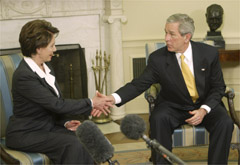
Bush Vs Pelosi

President George W. Bush broke bread with Democrat leader Nancy Pelosi on Thursday after her party's triumphant sweep of Congress, saying he's open to "any idea or suggestion" on winning in Iraq. ...
"Pelosi's expected appointment as the first woman speaker in the House of Representatives is 'historic for our country'," said Bush.
"As the father of young women, I think it's important. I really do."
Yeah - sure, George!
Hint : Pelosi means "hairy" in italian.
Translation - Things are liable to get hairy in the House, George!
Wednesday, November 08, 2006
Monday, November 06, 2006
Hall on Formalism
-------------------------------------------------------------------
From "Poetry and Ambition" Kenyon Review, n.s., 5, no. 4 (1983), and was reprinted in Pushcart Prize IX: Best of the Small Presses, 1984-85, and the AWP Bulletin, Feb.-Mar., 1987. Published in 1988 in Poetry and Ambition: Essays 1982-88 by Donald Hall.
Robert Thomas
Quarter Past Blue
It’s just the sort of paper-thin night
to make me steal the clapper from the mission bell
and leave it on your doorstep like a stuttered prayer.
In your room I see a writing light,
soft and dirty as an oyster.
I know you can hear me
out here in the static,
scraping on your pane like a raccoon.
I’ve been to the pond.
It’s not as if the swans were your personal secret.
Come out and walk with me across the Sonoma
town square, on the edge of the green.
I’m wearing my papier-mâché wings,
and they’re not yet dry. The moon’s been released
on its own recognizance. This is serious traffic, gridlock
intergalactical, Friday-night lust and spleen. This is
the it they mean when they say this is it. You are so
caught up in your own devotions. You are so not
what you think you are. It’s late,
half past revelation, quarter past blue,
and you’re still counting the chits, waiting for something
better than love as cold and magical as dry ice
to come along and sideswipe you, hit and run,
without leaving a scratch.
------------------------------------------------------
First published in Field; also appears in 2004 Pushcart Prize anthology.
Friday, November 03, 2006
The Poetry Workshop Conundrum - Deuxieme Partie
--------------------------------------------------------------------Donald Hall
Somebody get me a kleenex!
.
The Poetry Workshop Conundrum
--------------------------------------------------------------------Donald Hall
Thursday, November 02, 2006
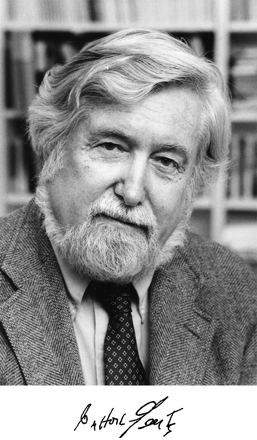
Clifford Geertz - August 23, 1926 - October 30, 2006

Clifford Geertz an icon of cultural anthropology and
author of "The Interpretation of Cultures".
"Clifford Geertz says it all in one crisp, succinct sentence: "I'm probably a closet rhetorician, although I'm coming out of the closet a bit." For over three decades, Geertz has been attempting to steer anthropological scholarship away from a rigidly scientific model and toward a humanistic, interpretive, hermeneutic model-apparently with great success. Perhaps it is Geertz's preoccupation with seeing science and scholarship as rhetorical, as socially constructed, that makes his work so eminently appealing to many of us in rhetoric and composition. Geertz sees rhetoric as central to his own life and work. From his college days as an English major at Antioch College and a copyboy at the New York Post to 1988 and his Works and Lives (where he "reads" the work of four major anthropologists as if he were a literary critic explicating canonical texts), Geertz has been consumed with questions of language, rhetoric, interpretation."
------------------------------------------------------------------GARY A. OLSON
Tuesday, October 31, 2006
Blue Fifth Review - Vol. VI - Issue 7 - Fall 2006 is Out.

Blue Fifth Review is online with work by Peter Pereira, Robert Lietz, Vicki Hudspith, Sheema Kalbasi, Donald Illich, Susan Elbe, Gerhardt Thompson, Leslie Marcus, Evie Shockley, Will Roby, Nick Bruno and more -
Monday, October 30, 2006
Here's a Picker-Upper
- We never know the value of our own work, and everything reasonable leads us to doubt it: for we can be certain that few contemporaries will be read in a hundred years. To desire to write poems that endure—we undertake such a goal certain of two things: that in all likelihood we will fail, and that if we succeed we will never know it.
- But for some people it seems ambitious merely to set up as a poet, merely to write and to publish. Publication stands in for achievement—as everyone knows, universities and grant-givers take publication as achievement—but to accept such a substitution is modest indeed, for publication is cheap and easy.
- True ambition in a poet seeks fame in the old sense, to make words that live forever. If even to entertain such ambition reveals monstrous egotism, let me argue that the common alternative is petty egotism that spends itself in small competitiveness, that measures its success by quantity of publication, by blurbs on jackets, by small achievement....
----------------------------------------------------------------------Donald Hall
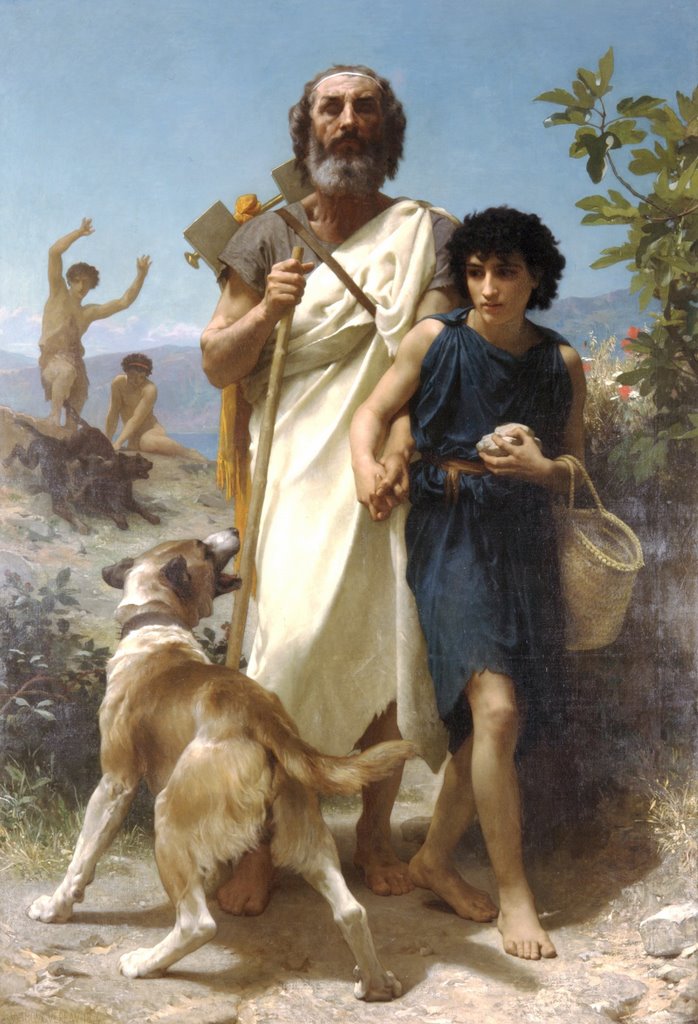
The Poem must become more important than the Poet!
------------------------------------------------------------------------
"Poetry and Ambition" was originally delivered as a lecture at a meeting of the Associated Writing Programs, then turned into an essay with the addition of material from another lecture given at New England College. It appeared in the Kenyon Review, n.s., 5, no. 4 (1983), and was reprinted in Pushcart Prize IX: Best of the Small Presses, 1984-85, and the AWP Bulletin, Feb.-Mar., 1987. Published in 1988 in Poetry and Ambition: Essays 1982-88 by Donald Hall.
Friday, October 27, 2006
Sylvia Plath
Edge
The woman is perfected
Her dead
Body wears the smile of accomplishment,
The illusion of a Greek necessity
Flows in the scrolls of her toga,
Her bare
Feet seem to be saying:
We have come so far, it is over.
Each dead child coiled, a white serpent,
One at each little
Pitcher of milk, now empty
She has folded
Them back into her body as petals
Of a rose close when the garden
Stiffens and odors bleed
From the sweet, deep throats of the night flower.
The moon has nothing to be sad about,
Staring from her hood of bone.
She is used to this sort of thing.
Her blacks crackle and drag.
--------------------------------------
"Selected Poems of Sylvia Plath" edited by Rebecca Warren
(York Notes Advanced) (Paperback) Longman (28- Sep- 2001)
Thursday, October 26, 2006
Seemed Like a Good Idea at the Time
Poetry in Vitro - Vol 1. No. 10
Marked and Stranded
Gauntly relating a man to a camel,
he stood at the dais; taking
us on the elevator down
to the basement; leading
us to the graveyard to find out why
his poetry had been eaten;
offering us a napkin
to wipe the ink off our faces.
------------------------------------
Wednesday, October 25, 2006
Running on Empty?
"Our skills are limited, our power / to imagine enfeebled." That's Mark Strand in his newest volume of poetry, Man and Camel, and, at least as far as his own work is concerned, it's hard to argue. The poverty of imagination on display would almost seem parodic if there were any indication that Strand had a sense of humor. "
-----------------------------------------------------------------Noah Berlatsky
"This eleventh collection by Mark Strand is a toast to life’s transience and abiding beauty. ... As always with Mark Strand, the discovery of meaning in the sound of language itself is an act of faith that enlightens us and carries us beyond the bounds of the rational."
------------------------------------------------------------------Borzoi Reader
"...Strand allows this new book to show all the signs of pruning and purging. The sieve of art descends into the well of intimate contemplation and retrieves 23 closely reasoned poems remarkably consistent in the character of the Baffled Seer persisting in the double terror (or is it joy?) of all Strand's expression: evanescence of the longed-for Other, desolate wonder of the self."
-------------------------------------------------------------------Richard Howard
An excerpt:
Man and Camel
On the eve of my fortieth birthday
I sat on the porch having a smoke
when out of the blue a man and a camel
happened by. Neither uttered a sound
at first, but as they drifted up the street
and out of town the two of them began to sing.
Yet what they sang is still a mystery to me—
the words were indistinct and the tune
too ornamental to recall. Into the desert
they went and as they went their voices
rose as one above the sifting sound
of windblown sand. The wonder of their singing,
its elusive blend of man and camel, seemed
an ideal image for all uncommon couples.
Was this the night that I had waited for
so long? I wanted to believe it was,
but just as they were vanishing, the man
and camel ceased to sing, and galloped
back to town. They stood before my porch,
staring up at me with beady eyes, and said:
“You ruined it. You ruined it forever.”
Black Sea
One clear night while the others slept, I climbed
the stairs to the roof of the house and under a sky
strewn with stars I gazed at the sea, at the spread of it,
the rolling crests of it raked by the wind, becoming
like bits of lace tossed in the air. I stood in the long,
whispering night, waiting for something, a sign, the approach
of a distant light, and I imagined you coming closer,
the dark waves of your hair mingling with the sea,
and the dark became desire, and desire the arriving light.
The nearness, the momentary warmth of you as I stood
on that lonely height watching the slow swells of the sea
break on the shore and turn briefly into glass and disappear . . .
Why did I believe you would come out of nowhere? Why with all
that the world offers would you come only because I was here?
Mother and Son
The son enters the mother’s room
and stands by the bed where the mother lies.
The son believes that she wants to tell him
what he longs to hear—that he is her boy,
always her boy. The son leans down to kiss
the mother’s lips, but her lips are cold.
The burial of feelings has begun. The son
touches the mother’s hands one last time,
then turns and sees the moon’s full face.
An ashen light falls across the floor.
If the moon could speak, what would it say?
If the moon could speak, it would say nothing.
My Name
Once when the lawn was a golden green
and the marbled moonlit trees rose like fresh memorials
in the scented air, and the whole countryside pulsed
with the chirr and murmur of insects, I lay in the grass,
feeling the great distances open above me, and wondered
what I would become and where I would find myself,
and though I barely existed, I felt for an instant
that the vast star-clustered sky was mine, and I heard
my name as if for the first time, heard it the way
one hears the wind or the rain, but faint and far off
as though it belonged not to me but to the silence
from which it had come and to which it would go.
--------------------------------------------------------------
from- "Man and Camel" - by Mark Strand - 2006
Knopf, a division of Random House, Inc.
Monday, October 23, 2006
Blog Squatters, Birthdays & Other Matters
Yesterday evening as I posted the entry that you presently see under Sunday October, 22, denoting that I would be taking a break from blogging, a “Blog Squatter” proceeded to post their announcements as comments under three separate posts. Now I don’t mind doing a little PR for somebody if they let me know about it, but an ad hoc comment which is simply an advertisement and doesn’t even feign interest in the post at hand is pretty low in my book.
Well needless to say, this infuriated me. And I said to hell with this hiatus. Nobody is going to hijack this blog. Whatever this reader thinks about it, it has my stamp on it and it is something I developed on my own without anybody else’s input. I realized that I cared enough about its existence that I deleted the offensive comments and made some editorial decisions regarding its content. This ain’t over by a long shot.
II
Yet another birthday is upon me and as a result it has me reflecting on this year’s yield and consequently I am reevaluating what I have accomplished with my blog. First, I must say that this blog has exceeded my expectations. Going into this, I hadn’t expected any readership. I did not anticipate that it would take off at all. After all, this blog grew out of the need to collect my thoughts on poetics and figurative art. By doing so I realized how much my tastes ran parallel in both domains.
Art had always been there for me. Growing up, I could always immerse myself in a composition in whatever medium. Painting and drawing were always second nature to me. Poetry has been a recent development. But here too I have already surpassed expectations. I started writing in 2001; started publishing in 2002 and have published over 35 poems in 23 journals & anthologies. Considering the turn-around time for most journals, I consider these figures to be quite good (at least by my standards).
What has eluded me so far mainly due to the fact that I have sent out a grand total of 2 MS. and have yet to enter a contest is publication of a chapbook. Perhaps, however, it is time to either put up or shut up. Book publication has not been a priority for me. I did not want to publish just for the sake of publishing. I wanted to be published when I had amassed enough material that I though worthy enough. I believe I have enough poems of worth to warrant a chapbook. And so I have started to entertain the thought.
III
Lastly, I am thankful that this community of poets (many of them are on my blogroll) has accepted me “tel comme je suis”. They have linked to me in greater number than I had ever thought possible without my intercession. But more importantly they have commented on what I have tried to communicate here in this on-line journal. Grazie a tutti!
I would also like to thank those of you who have sent me e-mails to the effect that I should continue blogging. Many pointed out that my blog was listed on their blogrolls and that they enjoyed my slant on things. But one e-mail in particular caught my attention as it directed me to something which had escaped me. This e-mail directed my attention to the fact that my poetry at The Arabesques Review is among the most popular receiving over 800 hits and counting. Furthermore, the poem “No.249 on the S.S. Saturnia” is highlighted in the “What’s in This Current Issue” blurb.
I am to say the least very happy about this. It means that my poetry is reaching readers that I never thought it would. It means to me that it is registering with the reader. Then I realized that that is the kind of success that I had wanted all along. It hadn’t been about the books or the critical acclaim. It had always been about the poem and the reader. So that whatever, I get coming to me after this is only icing on the cake. And yes, I really mean that!
Sunday, October 22, 2006
Friday, October 20, 2006
Tuesday, October 17, 2006
Monday, October 16, 2006
Because We Are Not Taken Seriously
Some night I wish they'd knock,
on my door, the government men,
looking for the poem of simple truths
recited and whispered among the people.
And when all I give them is silence
and my children are exiled
to the mountains, my wife forced
to renounce me in public,
I'll be the American poet
whose loneliness, finally, is relevant,
whose slightest movement
ripples cross-country.
And when the revolution frees me,
its leaders wanting me to become
"Poet of the Revolution," I'll refuse
and keep a list of their terrible reprisals
and all the dark things I love
which they will abolish.
With the ghost of Mandelstamon
one shoulder, Lorca on the other,
I 'll write the next poem, the one
that will ask only to be believed
once it's in the air, singing.
----------------------------------------
from: New & Selected Poems 1974-1994 - by Stephen Dunn -
Published by W.W. Norton, 1994 - 10110. ISBN.0-393-03618-9,
Saturday, October 14, 2006
Wednesday, October 11, 2006
MOVIE QUOTES & QUOTABLES FOR A $1000
A) - Which character in “Casablanca” actually said: " Play it, Sam. Play 'As Time Goes By.' " ?
1-Rick Blaine
2-Victor Laszlo
3-Guillermo Ugarte
4-Ilsa Lund
5-Capt. Louis Renault
B) - In “The Godfather”. to whom is Don Corleone speaking when he says, “I'm gonna make him an offer he can't refuse. Now, you just go outside and enjoy yourself, and uh, forget about all this nonsense. I want you, I want you to leave it all to me.” ?
1-Michael Corleone
2-Pete Clemenza
3-Johnny Fontane
4-Moe Green
5-Tom Hagen
C) - From “Raging Bull” – Who is this addressed to: “You know what that means? No matter how big I get, no matter who I fight, no matter what I do, I ain't never gonna fight Joe Louis.” ?
1-Vickie Thailer
2-Tommy Como
3-Joey LaMotta
4-Salvy Batts
5-Irma
D) - In “Citizen Kane”, Charles Foster Kane answers, “Yes. "Dear Wheeler: you provide the prose poems. I'll provide the war." in reply to whom?
1-Jedediah Leland
2-Mr. Bernstein
3-Mary Kane
4-Mr. Rawlston
5-Susan Alexander Kane
E) - From the movie adaptation of Tennessee Williams’, “Cat on a Hot Tin Roof” – Who is Big Daddy addressing when he says the following: “Didn't you notice a powerful and obnoxious odor of mendacity in this room?...There ain't nothin' more powerful than the odor of mendacity...You can smell it. It smells like death.” ?
1-Maggie
2-Big Mama
3-Gooper
4-Mae
5-Brick
F) – From “2001: A Space Odyssey” , who is the speaker of the following, “Just what do you think you're doing, Dave?” ?
1-Hal 9000
2-Dr. Charles Hunter
3-Dr. Jack Kimball
4-Dr. Victor Kaminsky
5-Dr. Frank Poole
G) – “Ben Hur” has Charlton Heston speaking these lines, “Their flesh...carries Rome's mark...the deed was not Messala's. I knew him, well, before the cruelty of Rome spread in his blood. Rome destroyed Messala as surely as Rome has destroyed my family.” to whom?
1-Quintus Arrius
2-Tiberius Caesar
3-Drusus
4-Pontius Pilate
5-Sheik Ilderim
H) – Dustin Hoffman in “The Graduate” utters “...All right, I promise, for Christ's sake, I promise never to take out Elaine Robinson...Let's not talk about it. Let's not talk at all.” to which character?
1-Elaine Robinson
2-Mrs. Braddock
3-Mrs. Robinson
4-Desk Clerk
5-Mr. Robinson
I) – Jem, the narrator’s brother in “To Kill a Mockingbird” is describing Boo Radley as follows: “Well, judgin' from his tracks, he's about six and a half feet tall. He eats raw squirrels and all the cats he can catch. There's a long, jagged scar that runs all the way across his face. His teeth are yella and rotten. His eyes are popped. And he drools most of the time.” to whom?
1-Charles Baker 'Dill' Harris
2-Jean Louise 'Scout' Finch
3-Atticus Finch
4-Calpurnia
5-Sheriff Heck Tate
J) – Last but not least who is Marlon Brando speaking to in "On the Waterfront" when he says, “You don't understand. I could'a had class. I could'a been a contender. I coulda been somebody, instead of a bum, which is what I am, let's face it.” ?
1-Father Barry
2-Johnny Friendly
3-Charley
4-Timothy 'Kayo' Dugan
5-Rhetorical
------------------------------------------------------------------------------
Ans. A) 4 B) 3 C) 3 D) 2 E) 5 F) 1 G) 4 H) 3 I) 1 J) 3
If you scored a 0 - And your name isn’t Paris Hilton or George Bush – What’s your excuse?
If you scored a 1 or 2 - I’ll assume that you were born after 1980 and think that movies in black and white are what they are referring to when they use the expression “Film Noire”
If you scored a 3 or 4 – I know somebody that’s related to a guy that shook Roger Ebert’s hand. Maybe he could give you some pointers.
If you scored a 5 or 6 –“ Why you look-a so sad? It’s-a not so bad. It’s-a nice-a place! Ah, shaddap a you face!” – Sorry for some reason I was channeling Joe Dolce.
If you scored a 7 or 8 – Look at the bright side: at least you don’t have to get pointers from that guy who shook Roger Ebert’s hand and never washed it.
If you scored a 9 or a 10 – You probably deserve a Movie Trivia Prize – But I ain’t givin’ you one.
Tuesday, October 10, 2006
Pilgrims
I.
I wanted to come home,
it just took too long to find the right plane.
Two years of eating grapes meant for wine,
wondering where the skin goes
when the flesh is juiced and fermented.
Maybe I would have thought of us
less if France had been more than cheese
and yardstick bread, more than yellow countryside
like Illinois when the corn is tall.
II.
I forgot how days pass in New York –
stubborn mist shaking its mane on the highway,
snow that siestas in the sky for days.
His green towel, folded and hung
on the bathroom door, smelling so much like him.
III.
Then Santiago de Compostela, where the hermit
found James under a transept of star,
his marrow drained, hair cleaned from skull. He waits
in stone sombrero, a staff cocked
in his left hand, a closed text in his right.
They think it’s the Bible, he winks,
and that these are my bones.
Finally, Ravenna, blackcaps warbling
on the telephone poles. Just south
of the pinewoods strangled by heather,
dog-rose, I ordered wedding soup.
I was finished with leaving,
with Europe
with the thousand stone churches
that starved their towns.
IV.
Somehow this would make more sense
if there were myrrh or bdellium involved.
Because then he would laugh, open
his palms that clench and unclench at his thigh,
smile at the plastic snow globe
I bought in the Turin airport.
I look at him, but he's watching the planes
lift like storks from the sandbar willows.
Didn’t you hear, he says when I ask
how Michigan has been. Christ came back
as a bamboo shark last week.
And the Devils brought home the Cup.
----------------------------------------------------
* From - Boxcar Poetry Review - September 2006
Erin Elizabeth Smith is a PhD candidate at the Center for Writers at the University of Southern Mississippi where she serves as editor-in-chief of Stirring and founder of Sundress Publications. Her poetry has appeared or is forthcoming in Third Coast, Crab Orchard, West Branch, Willow Springs, Natural Bridge, Gulf Stream, Good Foot, Slipstream, Bellingham Review, and Reed Magazine among others.
Thursday, October 05, 2006
The Poem You Asked For
My poem would eat nothing.
I tried giving it water
but it said no,
worrying me.
Day after day,
I held it up to the light,
turning it over,
but it only pressed its lips
more tightly together.
It grew sullen, like a toad
through with being teased.
I offered it money,
my clothes, my car with a full tank.
But the poem stared at the floor.
Finally I cupped it in
my hands, and carried it gently
out into the soft air, into the
evening traffic, wondering how
to end things between us.
For now it had begun breathing,
putting on more and
more hard rings of flesh.
And the poem demanded the food,
it drank up all the water,
beat me and took my money,
tore the faded clothes
off my back,
said Shit,
and walked slowly away,
slicking its hair down.
Said it was going
over to your place.
-------------------------------------
"Wrecking Crew", by Larry Levis - 1972 - University of Pittsburgh Press
Sunday, October 01, 2006
VALPARAISO POETRY REVIEW : Volume VIII, Number 1 - Fall/Winter 2006-2007
The Romans had a way
of talking to the dead: bring them
----- a bowl of blood.
But the blood
must be warm, which means
it must be yours.
Holding the long-
desired face between numb
hands that can’t feel shit
is difficult for some to take—others
find the whole scene over-
done. May I ask
what you would do,
given the chance?
Or Jared Carter's, "PROPHET TOWNSHIP":
The coffin would be kept in the parlor
for three days and nights. The watchers
took turns. After the funeral, neighbors
helped carry the box up to the attic
or set it out in one of the back rooms
so it would stay cold but not freeze.
Before the men tacked down the lid,
they filled it up the rest of the way
with rock salt. This was a custom
learned from their grandparents—
how to make it through till spring,
how to handle hardship on their own.
Or Perhaps Richard O'Connell's, "VOLADORES":
Spiral on spiral they undulate down
In aerial daring in the desert at dawn
Until the sun sets with the deified dead,
Celebrating the delirious death of all fear:
Sky diving, free falling, space walking delight,
The umbilical lethal dive into life.
-----------------------------------------------------
Add to this fine collection of poetry, book reviews by -- D.A. Jeremy Telman, Barbara Crooker, Roger Sedarat, Mike White, Lynn Strongin and Edward Byrne and essays entitled "Elizabeth Bishop's Poetic Voice: Reconciling Influences" by Laura Ebberson & "Marianne Boruch and the Art of Surprise" by Claire Keyes and you have an issue well worth the price of admission.
Friday, September 29, 2006
Gerald Stern
Since there was no mother for the peach tree we did it
all alone, which made the two of us closer
though closeness brought its loneliness, and it would
have been better I think sometimes to be sterile
from the start just to avoid the pain
which in my life this far has lasted seventy
years for I am in love with a skeleton
on whose small bones a dress hung for a while,
on whose small skull a bit of curly hair
was strung, and what is dust I still don’t know
since there was no mother to turn to then and ask
what else was she wearing, did she have on shoes,
and were the two trees from Georgia, and was it
true somebody said the other peach
should have died instead of her; and I could
imagine the nose going first though forty years later
the trees were still there and not as big as you’d think;
and it was my cousin Red with the flabby lips
who said it, he had red eyes, a red monstrosity,
a flabby body, half the house was filled with
male cousins, they were born in rooms a
short distance from the rats, I can’t remember
which ones had the accents nor what his
Hebrew name was, nor his English.
----------------------------------------------------
"My Sister’s Funeral" is reprinted from Everything is Burning ( 2005) - by Gerald Stern - published by W. W. Norton & Company, Inc.
Thursday, September 28, 2006
Saturday, September 23, 2006
Pet Peeves
If there is no true inherent system in poetics to judge whether poetry is "good" or "bad" or just plain "ugly"; then why is everyone so upset at David Lehman's choices - whether or not they smack of cronyism.
Friday, September 22, 2006
Notes - Re: Can Poetry be Judged by Objective Criteria?
If there is a set of criteria/elements (diction, syntax, line & half-meaning, trope & thought, rhetoric & speech, rhythm & combination etc...) which is necessary to define poetry as such, might there not be a similar guideline to determine whether that poetry is “good” or “bad”. Poetry (like all art) should resonate with the reader/consumer. It should as Robert Frost put it,"… begin with a lump in the throat, a home-sickness or a love-sickness. It is a reaching-out toward expression; an effort to find fulfillment. A complete poem is one where the emotion has found its thought and the thought has found the words."
Thus, it should move the reader – take them on a journey to some form of enlightenment (all the while entertaining them). If a poem does not engage us or (at its completion) has us saying- “So what?”, it has failed us. Does this make the poem “non-viable” or “bad”? Perhaps for us, as reader, but maybe not for others. If it works for more readers than it doesn’t for others; does that make it a good poem? That it is functional for at least one reader - may be a necessary condition for “viable” poetry; but not a sufficient one in my estimation for “good” poetry.

If for a moment we might imagine a circle as representing a poetic mindset, might it not be logical to assume that two circles might intersect when it comes to poetic aesthetics. Perhaps two like-minded individuals ( from the same school of poetic thought?) might be more likely to enjoy certain aspects of a poem. The overlap of these two circles might be greater than that of two readers from different aesthetics. However, by the very definition of poetry even two diverse poetic viewpoints must intersect at some point. There are certain expectations (however basic) on the part of the reader - vis a vis the pome, that must be met. Therefore, a “skillful” poem might then be one that readers from as many varied perspectives as possible can most agree upon as having some intrinsic value. Inevitably, is this not what makes a poem as viable today as somewhere down the road?
Perfectly Clear!
"I wrote poems I hoped no one could understand," he said. "If they did there would be no point in writing poetry. We still have to get over our mild hangover from that kind of modernism." ...
The poet talks about the "etiquette" of poetry, which calls on poets to be clear and comprehensible. In return, he imagines, they might actually attract readers.
"It took me a long time to figure out how to do that," he said. "It took me a long time to take the risk to be clear. People throw the word `risk' around in art. Usually it's applied to highly experimental work.
"The real risk in poetry these days is to be clear. If you're clear, if poetry follows a certain etiquette and uses standard punctuation, you're now exposed.
"You have nowhere to hide."
----------------------------------------------------------------------Billy Collins
-------------------------------------------------------
* source: The Register-Guard, Eugene, Oregon, USA
Wednesday, September 20, 2006
Canadian Content

(Heft) Subversive Intent - 2003

Enormous Changes: Each Wild Idea (Fountain Series) - 2005

Chapter 1: Each Wild Idea (Garden Series) - 2005
----------------------------------------------------------
Source: http://www.leokamengallery.com/artists/clayAllyson/clayAllyson.html
*Allyson Clay received her M.F.A. from the University of British Columbia, Vancouver. She has recently exhibited her work in Vancouver, Toronto, and Washington D.C.,
**Her work also appears in the new edition of Drunken Boat
Monday, September 18, 2006
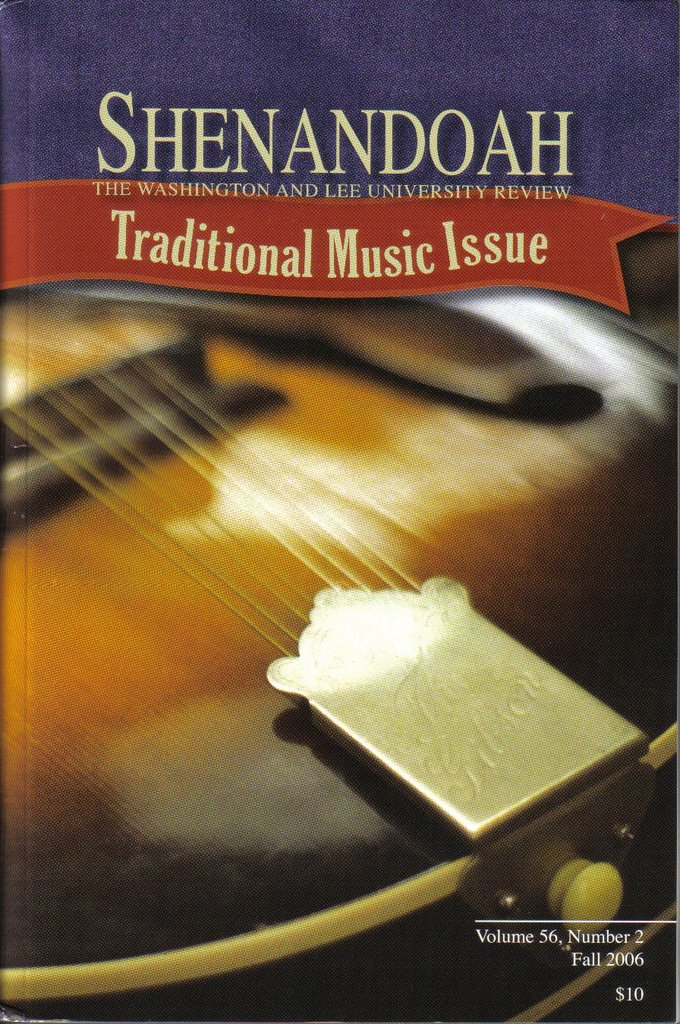
Shenandoah - Vol. 56. No. 2 - Fall 2006

Sampler: a poem by - John Savoie
Sweet Blues
Nose on breastbone, pursed lips
blow heat into her heart,
slide back and forth humming
her harmonica, the lithe
tongue searching all her stops,
high and low, musical
spit, the blues exploding
and earth shudders, the river
thrown off course, spilling
its banks where a barefoot man
knelt long ago to scoop
and squeeze and shape that clay
into the ripe image of
her magnificence, and sang,
oh yes he sang, sweet blues
down by the muddy water.
--------------------------------------
John Savoie won two Hopwood Awards for his poetry at the University of Michigan. His poems have appeared in Poetry, JAMA and The Evansville Review, and he teaches at Southern Illinois University, Edwardsville.
Saturday, September 16, 2006
Apropos
A SHIPWRECKED PERSON
----------------------------(James Tate )
When I woke from my afternoon nap, I wanted
to hold onto my dream, but in a matter of seconds
it had drifted away like a fine mist. Nothing
remained; oh, perhaps a green corner of cloth
pinched between my fingers, signifying what?
Everything about the house seemed alien to me.
The scissors yawned. The plants glowed. The
mirror was full of pain and stories that made no
sense to me. I moved like a ghost through the rooms.
Stacks of books with secret formulas and ancient
hieroglyphic predictions. And lamps, like stern
remonstrances. The silverware is surely more
guilty than I. The doorknobs don’t even believe
in tomorrow. The green cloth is burning-up. I
toss it into the freezer with a sigh of relief.
-----------------------------------------------------
Born in Kansas City, Missouri, he is the author of Return to the City of White Donkeys (2004); Memoir of the Hawk (2002); Shroud of the Gnome (1998); Worshipful Company of Fletchers (1995), which won the National Book Award; Selected Poems (1991), which won the 1992 Pulitzer Prize for Poetry and the William Carlos Williams Award; Distance from Loved Ones (1990); Reckoner (1986); Constant Defender (1983); Riven Doggeries (1979); Viper Jazz (1976); Absences(1972); Hints to Pilgrims (1971); The Oblivion Ha-Ha (1970); and The Lost Pilot (1967), selected for the Yale Series of Younger Poets... He is currently a Chancellor of The Academy of American Poets.
------------------------------------------------------------------(Source Wikipedia)
Thursday, September 14, 2006
Wednesday, September 13, 2006
You be the Judge!
So your assigment should you choose to accept it is to read the poetry (torture I'm sure) and determine if it is salvageable or not. This post will self-destruct in 24 hours or not! As always should your position be compromised I will deny any knowledge of your existence. Good luck!
Judgement has been rendered - thanks!
Monday, September 11, 2006
Louise Bogan
Knowledge
Now that I know
How passion warms little
Of flesh in the mould,
And treasure is brittle,--
I'll lie here and learn
How, over their ground
Trees make a long shadow
And a light sound.
---------------------------------------------
from Body of this Death: Poems (1923)