TRIESTE
by Joanna Pearson
Ports are made for entering and leaving,
thus this city redolent of sadness:
like walking off alone to cry, triste;
or, tryst, the lover’s short-lived entanglement,
almost foreboding happiness, but only for a moment.
Two people giggling temporarily on sunlight and Chianti—
like that joy, it doesn’t last long.
We drove here, our last stop, from Sloveniain
a banged-up communist-era two-door car.
This former center of industry and ships,
its harbor filled with cranes and metal works,
seemed too ugly to be Italy almost,
except for the chatter of girls
clattering on heels, the leather stores,
and baby cappuccinos, the women’s tiny waists
and dark hair, their hands swirling
with furious significance, their words rolling,
glamorous and vowel-rich. Ahhhhh.
We saw an amphitheater in ruins,
climbed the hill that overlooks the city.
The Adriatic stretched meaningless before us
yawning a great blue, speckled with boats stalled with their cargo
and cruise ships drifting off to Venice. To the left
the land melted toward the Croatian coast.
Our backs dripped, we squinted through sunglasses,
and wandered into Indian import shops,
fingering cool silk saris and batik shirts,
eyeing bangles and semiprecious stones.
Flip-flopping down the sidewalk, we watched
men push up the shirtsleeves of their light shirts
and frown into folded gazettes beneath the awnings,
impatient for the news from elsewhere.
The gelato stands were still beneath the noise of flies,
their abandoned colors dripping, sickly bright.
It was a hot July. We sat sticky-legged at the station,
bored voyeurs with our lives on pause,
watching other people idle away the morning,
stir lukewarm café con leche, one man running for his train,
another pleading, face to the sky, as his girlfriend left him.
We saw him cry, not even wiping off his tears:
an ancient taste, and Trieste, an ancient city
with its centuries’ accumulation
of leaving.
---------------------------------------------------------------------
from Stirring : A Literary Collection Volume 8, Edition 2 : February 2006
Joanna Pearson's work has been included in Best New Poets 2005, the anthology edited by George Garrett and published in conjunction with Meridian at UVA. Her writing has also appeared recently or is forthcoming in the Mississippi Review, storySouth, JAMA, The Raleigh News & Observer, The 2River View, The Journal of Medical Humanities, Small Spiral Notebook, Amarillo Bay, Poetryfish, and Yemassee, where it received the Editor’s Award. She lives in Baltimore, MD.
Saturday, February 18, 2006

Thursday, February 16, 2006
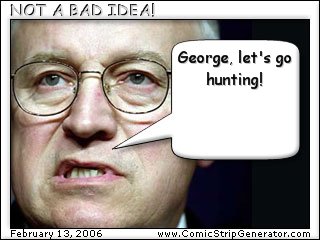
Top Ten Dick Cheney T-Shirt Logos!
10 - Cheney's Got a Gun
-----Cheney's Got a Gun
-----Everybody Had Better Run
-----'Cause Cheney's Got a Gun
9 - Dick Cheney: Weapon of Mass Destruction!
8 - Guns Don't Shoot People - Dick Cheney Does!
7 - I'd Rather Be Bill Clinton's Intern,
---Than Dick Cheney's Hunting Partner.
6 - Dick Cheney's Hunting Tip No.1:
----Shoot First; Don't Answer Questions Later!
5 - Be Vewwwy Quiet!
----Dick Cheney is Hunting!
4 - How many lawyers does it take to make a covey?
3 - Dick Cheney - Seasoned Lawyers Quail Before Him!
2 - The Bush Doctrine: Shoot First, Aim Later!
1 - They Shoot Republicans - Don't They?
-----Cheney's Got a Gun
-----Everybody Had Better Run
-----'Cause Cheney's Got a Gun
9 - Dick Cheney: Weapon of Mass Destruction!
8 - Guns Don't Shoot People - Dick Cheney Does!
7 - I'd Rather Be Bill Clinton's Intern,
---Than Dick Cheney's Hunting Partner.
6 - Dick Cheney's Hunting Tip No.1:
----Shoot First; Don't Answer Questions Later!
5 - Be Vewwwy Quiet!
----Dick Cheney is Hunting!
4 - How many lawyers does it take to make a covey?
3 - Dick Cheney - Seasoned Lawyers Quail Before Him!
2 - The Bush Doctrine: Shoot First, Aim Later!
1 - They Shoot Republicans - Don't They?
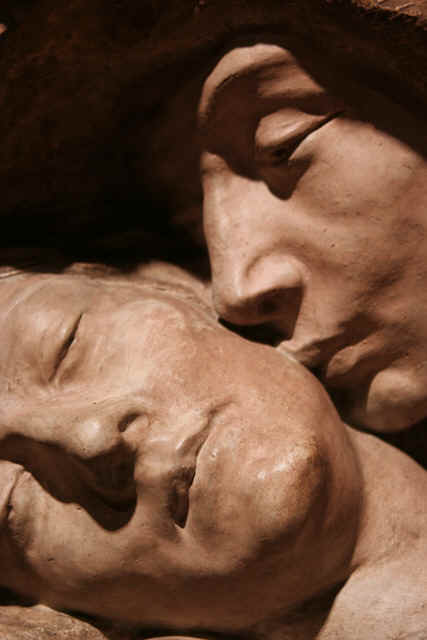
The Death of Melic Review: Final Issue # XXVII
Melic Review
Final Issue # XXVII
Selected artwork by Scott Odom
The Melic Poetry Workshop was one of the first on-line forums that I called a home of sorts. There were some great moderators there and of course the presence of C.E. Chaffin was always felt. His critique was always apropos and incisive and he didn't mind posting one of his own from time to time. His work on the Melic Review was also exemplary and it is no wonder that it flourished for nine years. The final issue No. XXVII contains the following writers & poets:
Marcus Bales
Norm Ball
Walter Bargen
Christopher Barnes
Kristy Bowen
Greg Braquet
Laurie Byro
Jared Carter
C.E. Chaffin
Srinjay Chakravarti
Phillip Henry Christopher
Debi Cimo
Alfred Corn
Debra Di Blasi
Camille Dungy
Taylor Graham
John Gray
Frank Haberle
Jessica Harris
Bob Hicok
Mark Jackley
Ariana-Sophia Kartsonis
Kirsten Kaschock
Meg Kearney
Charles Lowe
Rachel Mallino
Frank Matagrano
Cathy McArthur
Michael Mobley
V.C. Nash
Richard Newman
Chris O’Carroll
Scott K. Odom
Lee Passarella
Lee Ann Roripaugh
Jim Simmerman
Andrew Slattery
Gary Sloboda
Michael Virga
Emily Waples
Dara Wier's
Michael White
Can V. Yeginsu
A Sampler:
The Wind’s Odd Needlepoint
by Frank Matagrano
It is January 23rd and the image of me doesn’t care
that four to six more inches are expected to fall late
tonight. The image of me will not offer to shovel
the driveway tomorrow morning, nor will he scrape
ice off the windshield. Most likely, he will be lying
in bed or roaming around the house in a bathrobe, trying
to remember the name of an old acquaintance who made
a cameo in last night’s dream. But at the moment, it is still
January 23rd and I am watching the image of me whisper
sweet things to the image of my first wife, who now lives
in Colorado, where it takes weeks for the sun to go down
and where they are making omelets in the kitchen
with something that looks like an onion though no one is
crying. The smell, Old Wisdom says, comes off your hands
with lemon juice. Pharaohs were buried with onions, bound
to their ears and soles. One king was entombed
with a bulb in each eye. He was found
flowering. I am feeling out loud. I don’t know
a better way to work through this stuff, and believe
you me, it is January 23rd and I am dragging out
the bedroom from my last apartment to give
the image of me a place to stretch, a chance
to reach across the mattress and trace
the mouth of a certain memory. There are people who love
things that cannot love them back in the same way, things unable
to say Yes, unable to say I never stopped ___________, things lost
in the drift. Banks of old snow are piled high along the roadside,
the tops sewn by the wind’s odd needlepoint into a sheet
and draped over the road, as if to put these things to rest.
** poem originally published in the Cimarron Review
Tuesday, February 14, 2006
Per Aurora
Time and Again
Time and again, however well we know the landscape of love,
and the little church-yard with lamenting names,
and the frightfully silent ravine wherein all the others
end: time and again we go out two together,
under the old trees, lie down again and again
between the flowers, face to face with the sky.
Rainer Maria Rilke
1875-1926
Monday, February 13, 2006
Friday, February 10, 2006
No Instructions Necessary!
[You are reading this too fast.]
by Ken Norris
You are reading this too fast.
Slow down for this is poetry
and poetry works slowly.
Unless you live with it a while
the spirit will never descend.
It's so easy to quickly cut across the surface
and then claim there was nothing to find.
Touch the poem gently with your eyes
just as you would touch a lover's flesh.
Poetry is an exercise in patience,
you must wait for it to come to you.
The spirit manifests in many guises;
some quiver with beauty,
some vibrate with song.
What is happening?
Slow down, slow down,
take a few deep breaths,
read the poem slowly,
read the words one at a time,
read the words one by one,
and the spaces between the words,
get sleepy, this is poetry,
relax until your heart
is vulnerable, wide open.
--------------------------------------------------
From Canadian Poetry Now: 20 Poets of The '80's
Edited by Ken Norris
1984 - House of Anansi Press
Ken Norris was born in New York City in 1951. He emigrated to Canada in the early seventies and quickly became one of Montreal’s infamous Véhicule Poets. He attended SUNY at Stony Brook (B.A.), Concordia University (M.A.), McGill University (Ph.D.). Recognized as one of Canada’s most prolific poets, Norris has always given his readers quirky and edgy poetry that continually reveals unanticipated possibilities and explores new horizons. He is the author of two dozen books and chapbooks of poetry, and he is the editor of eight anthologies of poetry and poetics. His work has also been widely anthologized in Canada and in the English-speaking world, as well as published in translation in France, Belgium and Israel. His 1998 poetry volume Limbo Road has recently been translated into French by Pierre Des Ruisseaux and published by Écrits des Forges.
Norris now teaches Canadian literature and creative writing at the University of Maine and divides his time among the U.S., Canada and the Caribbean.
Books by Ken Norris
Dominican Moon
Fifty
Hotel Montreal: New and Selected Poems
Limbo Road
Thursday, February 09, 2006
Early Works
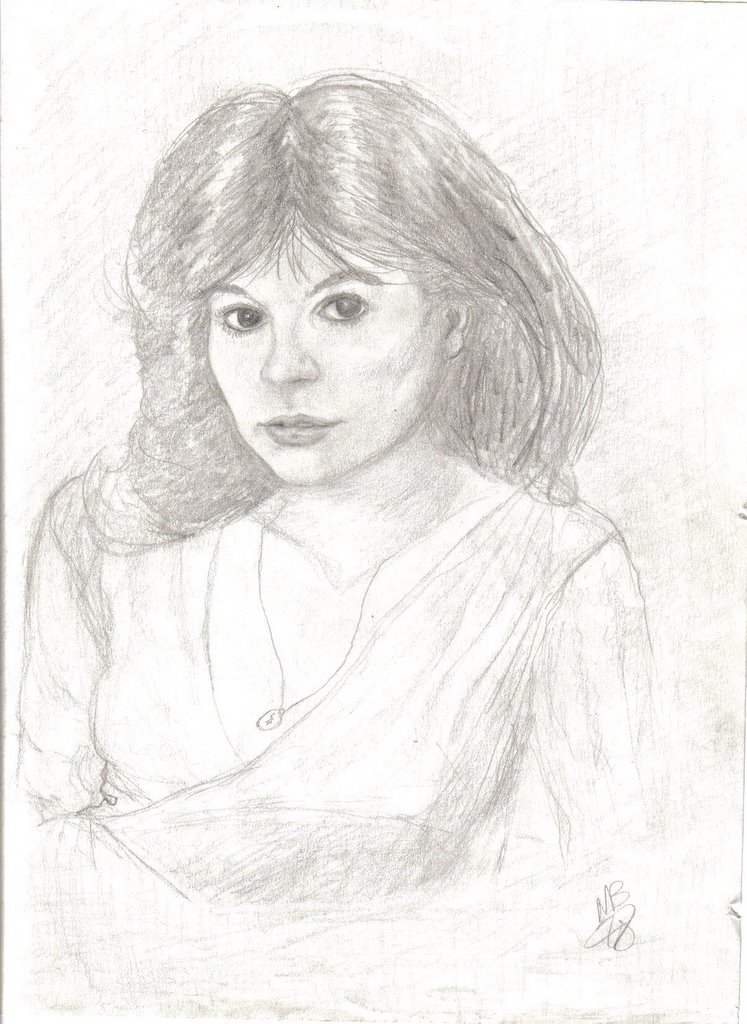
Portrait of Linda
Pencil on paper
circa 1978

Self Portrait
Pen & Ink on paper
circa 1980

Study for Mural - "The Way of Life"
charcoal on paper
circa 1981
Tuesday, February 07, 2006

Monday, February 06, 2006
Galaway Kinnell

On Frozen Fields
1
We walk across the snow,
The stars can be faint,
The moon can be eating itself out,
There can be meteors flaring to death on earth,
The Northern Lights can be blooming and seething
And tearing themselves apart all night,
We walk arm in arm, and we are happy.
2
You in whose ultimate madness we live,
You flinging yourself out into the emptiness,
You - like us - great an instant,
O only universe we know, forgive us.
Thursday, February 02, 2006
On Stereotypes, Typifications & "Goombas"
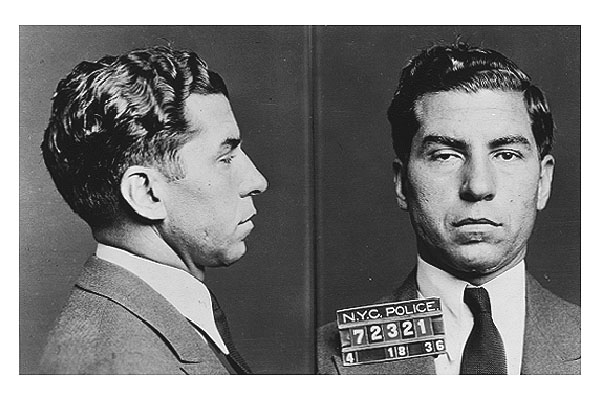
What’s Wrong With This Picture
Now the truth of the matter is that we all do it. We do it every day. Every day we wake up, shower, primp and comb; dress, eat breakfast and race to our daily grinds. Every day we go out carefully into our socially constructed realities. In the process, each and every day we use stereotypes or typifications. For instance in a busy social setting (i.e. - street corner at rush-hour) our minds use social constructs to quantify and qualify all the data that is inputted by our senses.
“The reality of everyday life contains typificatory schemes in terms of which others are apprehended and “dealt with” in face to face encounters. Thus I apprehend the other as “a man” [“a woman”], a European, a buyer “a “jovial type” [etc…].” * Unless challenged (whether internally or externally) these typifications will hold sway until further notice and will affect one’s actions in this social milieu. The other person also apprehends us in a typified way. The ensuing interaction is a negotiation of sorts.
“Thus, most of the time, my encounters with others in everyday life are typical in a double sense – I apprehend the other as a type and I interact with him[her] in a situation that is itself typical.” ** The typifications of social interaction become more and more anonymous the further away they are from the immediate face to face social interaction. In fact these typifications inevitably become empty projections; social constructs that are almost completely devoid of individualized content. Some of this content may even contain elements of the mythical or legendary. This fact does not impede the anonymity of these constructs or typifications to enter as decisive elements in the reality of everyday life. The social reality of everyday life is thus cognitively received in a continuum of typifications.
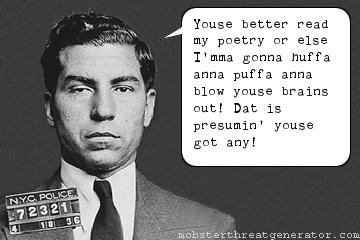
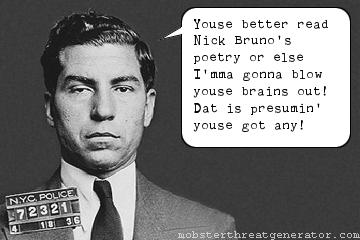
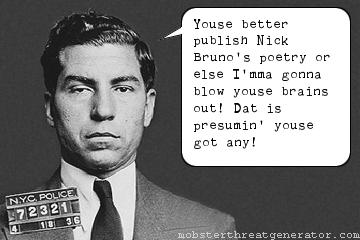
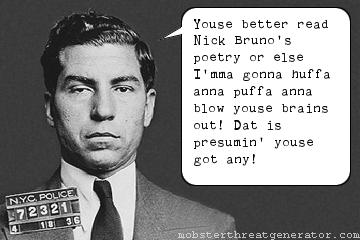
Now when one sees this swarthy looking man of Mediterranean descent we immediately typify or stereotype him. Question is what “typificatory scheme “ does one envision for this persona. Even if this were not a “mug-shot”, I do not believe it would be a positive objectification. Irrespective of its context we have already woven a stereotype of him. We have projected our cognitive mindsets onto him – real or imagined- legendary or based on fact. Of course this is Charles "Lucky" Luciano (1897-1962) and yes he was a legendary Italian American mobster: considered the father of the National Crime Syndicate and the mastermind of the massive postwar expansion of the international heroin trade.
But why has Luciano been singled out and given the dubious honor of representing mobsters? Why doesn’t the site: Mobster Threat Generator (affiliated with Bright Bomb Inc. of California) offer other choices such as: Dutch Schultz , Meyer Lansky or even Bugsy Siegel just to name a few of Luciano’s contemporaries? Why has the HBO hit series “The Sopranos” chosen to depict Italian Americans that are involved in organized crime? Why not portray an Italian American/Canadian family that works hard and contributes in a positive fashion to the American/Canadian way of life? Because it plays better that’s why. Because it’s easier to prop up these typifications that contain mythical elements than to portray reality without prevarication. Because it’s hollywood. Because a North American viewing public eats it up.
...Rant over!
-----------------------------------------------------------------------
* & ** - (Berger & Luckman:1967 - "The Social Construction of Reality")
Wednesday, February 01, 2006

Tuesday, January 31, 2006

Monday, January 30, 2006
Sunday, January 29, 2006
Deja Digerati

Pre-order the book before February 14th
and save 10%, shipping included, for only $14.32.
This is a special, limited-time offer.
Order Here: Three Candles Press
Digerati: 20 Contemporary Poets in the Virtual World
Release Date: February 14, 2006
330 pages, price $15.95,
ISBN: 0-9770892-2-3
Peter Pereira
Eduardo C. Corral
Aaron Anstett
Paul Guest
Alison Pelegrin
Teresa Ballard
RJ McCaffery
Seth Abramson
Nancy Eimers
Anthony Robinson
Deborah Keenan
Tony Trigilio
Lee Ann Roripaugh
Shanna Compton
Jake Adam York
Michael Meyerhofer
Matthew Shindell
Jacqueline Marcus
William E. Stobb
Frank Matagrano
---------------------------------------------
* Tip of the hat to Steve Mueske who put it all together.
Saturday, January 28, 2006
Christina Patterson Asks: Is poetry the new Prozac? - Question is for whom?
“Poetry is good for your health” Patterson states in her article in The Independent (online edition) – but then again you’ve known that for a while.
· A recent study in the journal Psychological Reports, suggested that writing poetry boosted levels of secretory immunoglobin A.
· Another, undertaken by a consultant at Bristol Royal Infirmary, concluded that poetry enabled seven per cent of mental health patients to be weaned off their anti-depressants.
· Poetry, it seems, is not the new rock'n'roll, but the new Prozac.
But writing it is not necessarily beneficial for poets:
“Many poets - a higher proportion, apparently, than of the average population - are not so lucky. John Clare, Anne Sexton, Robert Lowell and, most famously, Sylvia Plath, all knew the torments of a mind that would, on occasion, burst out of the crucible of what Freud called "normal human misery" into the nameless horrors of mania. The mad poet may be a cliché, but it is not a myth. Poets continue to write of their experiences of mental illness. If poetry is some kind of wonder-drug, it sure ain't working for them.”
So who’s forwarding theories like the ones above? According to Patterson it’s the arts administrators and they're doing it for money. (Of course it’s all for a good cause.) But in order to get the money, they need to go to the funders with evidence via studies that support their assertions. How much of this “research” is “anecdote masquerading as science” depends on which side of the fence your on I guess.
Patterson concludes with the following: “There is, in the right hands, a fine role for poetry as social work, but let's not pretend that it's the same as poetry as art. Poetry, like all art, is not a panacea. Perhaps it's more like homeopathy. A great placebo - some people swear by it - but the studies are inconclusive.”
· A recent study in the journal Psychological Reports, suggested that writing poetry boosted levels of secretory immunoglobin A.
· Another, undertaken by a consultant at Bristol Royal Infirmary, concluded that poetry enabled seven per cent of mental health patients to be weaned off their anti-depressants.
· Poetry, it seems, is not the new rock'n'roll, but the new Prozac.
But writing it is not necessarily beneficial for poets:
“Many poets - a higher proportion, apparently, than of the average population - are not so lucky. John Clare, Anne Sexton, Robert Lowell and, most famously, Sylvia Plath, all knew the torments of a mind that would, on occasion, burst out of the crucible of what Freud called "normal human misery" into the nameless horrors of mania. The mad poet may be a cliché, but it is not a myth. Poets continue to write of their experiences of mental illness. If poetry is some kind of wonder-drug, it sure ain't working for them.”
So who’s forwarding theories like the ones above? According to Patterson it’s the arts administrators and they're doing it for money. (Of course it’s all for a good cause.) But in order to get the money, they need to go to the funders with evidence via studies that support their assertions. How much of this “research” is “anecdote masquerading as science” depends on which side of the fence your on I guess.
Patterson concludes with the following: “There is, in the right hands, a fine role for poetry as social work, but let's not pretend that it's the same as poetry as art. Poetry, like all art, is not a panacea. Perhaps it's more like homeopathy. A great placebo - some people swear by it - but the studies are inconclusive.”
Friday, January 27, 2006
Say Isn't This Supposed to be a Poetry Blog?
Six Weeks After
by Maxine Kumin
two roistering dogs splayed me flat
on frozen turf shattering six ribs
consigning me to gray walls, bleak thoughts
I'm up and about , hitching from place to place
and I see the common coarse-grained stones
have not given up their good seats in the wall
though the deckle-edged daffodils came and went
while I motored my rented bed up and down
and I see the greening margin along the road
is shaggy and unshorn and the goldfinches
have exchanged their winter costumes
for strobic lozenges of yellow that brighten
the window feeder and an indigo
bunting has brought his electric blue
to my sphere so that each time the rose-
breasted grosbeak alights for a sunflower chip
I am stunned into wholeness, healed
by a wheel of primary colors.
------------------------------------------------------
Shenandoah: Vol 55 - No. 3 - Winter 2005
Thursday, January 26, 2006

Wednesday, January 25, 2006
The Straussians Are Coming! The Straussians Are Coming!
I
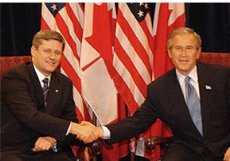
Donald Gutstein wrote an intriguing article for “The Tyee” a B.C. alternative daily newspaper. In it he draws some interesting analogies between Stephen Harper & George Bush: “What do close advisors to Stephen Harper and George W. Bush have in common? They reflect the disturbing teachings of Leo Strauss, the German-Jewish émigré who spawned the neoconservative movement. …In Washington, Straussians exert powerful influence from within the inner circle of the White House. In Canada, they roost, for now, in the so-called Calgary School, guiding Harper in framing his election strategies. What preoccupies Straussians in both places is the question of "regime change."
Who was Leo Strauss? Leo Strauss (September 20, 1899 – October 18, 1973), was an American conservative political philosopher of German-Jewish extraction, who specialized in the revitalization of classical philosophy and founded an intellectual school, Straussianism, during his decades at the University of Chicago.
Strauss called his field Political Philosophy. But for him political philosophy and philosophy were necessarily intertwined at their roots. Like many philosophers since the second world war, he did not believe in trying to distinguish facts and values in philosophy and he was against positivism.
Strauss taught that Liberalism, strictly speaking, contained within it an intrinsic tendency towards relativism, which in turn led to a sort of nihilism--a kind of decadence, value-free aimlessness, and hedonism which he believed he saw permeating through the very fabric of contemporary American society. In the belief that 20th century relativism, scientism, historicism, and nihilism were all implicated in the deterioration of modern society and philosophy,… (source Wikipedia)
II
Strauss believed in the inherent inequality of humanity. Most people, he famously taught, are too stupid to make informed decisions about their political affairs. Strauss believed that allowing citizens to govern themselves will lead, inevitably, to terror and tyranny, as the Weimar Republic succumbed to the Nazis in the 1930s. Elite philosophers must decide on affairs of state for us. (George this does not mean you!) They must resort to deception -- Strauss's "noble lie" -- to protect citizens from themselves. The elite must hide the truth from the public by writing in code. "Using metaphors and cryptic language," philosophers communicated one message for the elite, and another message for "the unsophisticated general population,". … "For Strauss, the art of concealment and secrecy was among the greatest legacies of antiquity."
Apparently, according to Gutstein, there is an elite inner circle of Staussians in the White House and another in place in the so-called Calgary School, waiting to exert their influence in guiding Harper when he is firmly ensconced in Ottawa. These Canadian Straussians claim that “The Canadian Charter of Rights and Freedoms is the end result of a conspiracy foisted on the Canadian people by "special interests." These nasty people are feminists, gays and lesbians, the poor, prisoners and refugee-rights groups who are advancing their own interests through the courts at the expense of the general public." This is a common Straussian technique: “deception by omission” where the weak are targeted while the real culprits disappear.
As noted, what also preoccupies Straussians in both places is the question of "regime change”. "Strauss defined a regime as a set of governing ideas, institutions and traditions. …Usually regime change is imposed on a country from outside through violent means, such as invasion (i.e. Iraq etc…). On occasion, it occurs within a country through civil war. …Is regime change possible through the electoral process? It's happening in the U.S., where the neocons are succeeding in transforming the American state from a liberal democracy into a corporatist, theocratic regime. " As Canada readies for a new federal government, the question is: Are we next?
III
How much of this reportage is Gutstein’s own private brand of political paranoia and how much is based in fact is pretty hard to ascertain given that the “Straussians” seem to function best in a covert manner - a la “Freemasons”. The fact that both leaders may in effect have advisors that ascribe to this school of thought does not in and of itself mean that there is a secret agenda or that they all belong to some “Masonic Lodge”.
Harper’s views and the political platform that he delineated during his recent campaign, lie well within the boundaries that circumscribe the “Conservative Party’s” view of society. What is worrisome is what was contained in the speech that he gave in 2003, to a group called Civitas. This organization, is a network of Canadian neoconservative and libertarian academics, politicians, journalists and think tank propagandists.
Harper stated in this address that : “The state should take a more activist role in policing social norms and values. To achieve this goal, social and economic conservatives must reunite as they have in the U.S., where evangelical Christians and business rule in an unholy alliance. Red Tories must be jettisoned from the party and alliances forged with ethnic and immigrant communities who currently vote Liberal but espouse traditional family values. …Movement towards the goal must be "incremental," he said, so the public won't be spooked.”
Regime change, one step at a time???
Tuesday, January 24, 2006
The True North Strong & Conservative
Stephen Harper wins Conservative minority
by Phil Hahn, CTV.ca News
Canadians granted Conservative Leader Stephen Harper a minority government Monday, putting an end to more than 12 years of Liberal rule.
Results show Conservatives won 124 seats, versus 103 for Paul Martin's Liberals.
"Tonight, friends, our great country has voted for change," the prime minister-designate told a crowd of supporters at his home riding of Calgary Southwest.
"And Canadians have asked our party to take the lead in delivering that change. Tonight I am saying to all Canadians that we will respect the trust you have given us, we will keep our word, we will honour that trust, we will deliver on our commitments."
Harper then reached out to the regions, repeating a campaign promise to solve the fiscal imbalance and promising to let the Atlantic provinces keep their offshore resource money.
The West, he said, will now have the voice in Ottawa it has long sought.
But Harper fell short of the 155 seats needed to lead a Tory majority, meaning he'll have to wheel and deal and curry favour of at least one opposition party to support him in the 308-seat House of Commons.
The Bloc Quebecois won 51 seats, while the NDP took 29 -- a double-digit gain from the 2004 election. All four major party leaders won their ridings.
By the end of the night, the Tories won roughly 36 per cent of the popular vote nationwide, compared with 30 per cent for the Liberals, 17 per cent for the NDP and 10 per cent for the Bloc.
NATIONAL STANDINGS (Seats: 308/308)
------------------------------------------------------------------Total
Conservatives-----------------------------------------------------124
Liberals-------------------------------------------------------------103
Bloc Quebecois------------------------------------------------------51
New Democratic Party----------------------------------------------29
Independent----------------------------------------------------------1
Green Party---------------------------------------------------------- 0
For complete election results and breakdown: Election 2006
by Phil Hahn, CTV.ca News
Canadians granted Conservative Leader Stephen Harper a minority government Monday, putting an end to more than 12 years of Liberal rule.
Results show Conservatives won 124 seats, versus 103 for Paul Martin's Liberals.
"Tonight, friends, our great country has voted for change," the prime minister-designate told a crowd of supporters at his home riding of Calgary Southwest.
"And Canadians have asked our party to take the lead in delivering that change. Tonight I am saying to all Canadians that we will respect the trust you have given us, we will keep our word, we will honour that trust, we will deliver on our commitments."
Harper then reached out to the regions, repeating a campaign promise to solve the fiscal imbalance and promising to let the Atlantic provinces keep their offshore resource money.
The West, he said, will now have the voice in Ottawa it has long sought.
But Harper fell short of the 155 seats needed to lead a Tory majority, meaning he'll have to wheel and deal and curry favour of at least one opposition party to support him in the 308-seat House of Commons.
The Bloc Quebecois won 51 seats, while the NDP took 29 -- a double-digit gain from the 2004 election. All four major party leaders won their ridings.
By the end of the night, the Tories won roughly 36 per cent of the popular vote nationwide, compared with 30 per cent for the Liberals, 17 per cent for the NDP and 10 per cent for the Bloc.
NATIONAL STANDINGS (Seats: 308/308)
------------------------------------------------------------------Total
Conservatives-----------------------------------------------------124
Liberals-------------------------------------------------------------103
Bloc Quebecois------------------------------------------------------51
New Democratic Party----------------------------------------------29
Independent----------------------------------------------------------1
Green Party---------------------------------------------------------- 0
For complete election results and breakdown: Election 2006
Monday, January 23, 2006



Subscribe to:
Posts (Atom)