Friday, October 07, 2005

Wednesday, October 05, 2005

Tuesday, October 04, 2005
Singular Twist of Fate
I got an SASE back today in the mail. It was from the Indiana Review; postdated September 30, 2005. So I figure...This is Guinness World Record material for a rejection from a print journal. I mean I sent the sucker out on September 26, 2005 and I receive the SASE on October 4th of the same year nonetheless. What did they use the pony express? Then I thought: Gee.... I didn't think my sub was that bad. So I open the sucker up and I read the rejection slip.
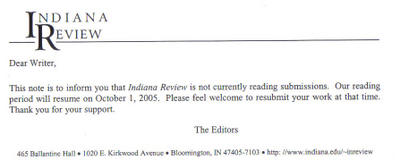
Now let me get this straight. I sent my sub on September 26, figuring that it'll take about 4 to 10 days to get there just in time for October 1st . Instead by some freak occurrence they get it within a couple of days maybe and they're whipping it back at me by September 30th. But I mean October 1st is like the next day. Do you get the impression (like me) that they never even took a look at the sucker and that right about now my poetry, printed on Xerox Ultra White 20 lb standard weight paper, is being abused and tortured into admitting that it's vapid and meaningless drivel by some intern? Something tells me I shouldn't waste my time and money sending them another sub. But then I figure what the hell...even interns have to have some fun.
Now let me get this straight. I sent my sub on September 26, figuring that it'll take about 4 to 10 days to get there just in time for October 1st . Instead by some freak occurrence they get it within a couple of days maybe and they're whipping it back at me by September 30th. But I mean October 1st is like the next day. Do you get the impression (like me) that they never even took a look at the sucker and that right about now my poetry, printed on Xerox Ultra White 20 lb standard weight paper, is being abused and tortured into admitting that it's vapid and meaningless drivel by some intern? Something tells me I shouldn't waste my time and money sending them another sub. But then I figure what the hell...even interns have to have some fun.
100 Blogging Poets In 100 Days
Billy Jones is profiling 100 poets who blog on his site at BloggingPoets. Here is a partial list of poets (as today is day 23). The list is in no particular order as is clear from the sequence of Blogs highlighted below. Heck, I don't even belong on a list of poets such as: Collin Kelly, Ron Silliman, Peter Pereira, Laurel Snyder et al. I look forward to seeing who else is profiled.
1. Talking To Myself
2. Alivianate El Coco Highlighted here.
3. Poetry Hut Highlighted here.
4. Ginger Rivers Highlighted here.
5. Tread On Dreams Highlighted here.
6. Stick Poet Super Hero Highlighted here.
7. Poetic Acceptance Highlighted here.
8. They Shoot Poets Highlighted here.
9. Ron Silliman Highlighted here.
10. Blog Poetry Club Highlighted here.
11. Million Poems Highlighted here.
12. JewishyIrishy Highlighted here.
13. The Virtual World Highlighted here.
14. Never Neutral Highlighted here.
15. Night Jar Highlighted here.
16. Stranger Ken Highlighted here.
17. Te Quiero Highlighted here.
18. Glittering Muse Highlighted here.
19. A Poem A Day Highlighted here
20. Watermark Highlighted here.
21. Yemenja Highlighted here.
22. Collin Kelly Highlighted here.
23. Blue Tattoo Highlighted here.
Monday, October 03, 2005
Chilling Read
Re-creating the Scene
by Yusef Komunyakaa
The metal door groans
& folds shut like an ancient turtle
that won't let go
of a finger till it thunders.
The Confederate flag
flaps from a radio antenna,
& the woman's clothes
come apart in their hands.
Their mouths find hers
in the titanic darkness
of the steel grotto,
as she counts the names of dead
ancestors, shielding a baby
in her arms. The three men
ride her breath, grunting
over lovers back in Mississippi.
She floats on their rage
like a torn water flower,
defining night inside a machine
where men are gods.
The season quietly sweats.
They hold her down
with their eyes,
taking turns, piling stones
on her father's grave.
The APC rolls with curves of the land,
up hills & down into gullies,
crushing trees & grass,
droning like a constellation
of locusts eating through bamboo,
creating the motion for their bodies.
She rises from the dust
& pulls the torn garment
around her, staring after the APC
till it's small enough
to fit like a toy tank in her hands.
She turns in a circle,
pounding the samarium dust
with her feet where the steel
tracks have plowed. The sun
fizzes like a pill in a glass
of water, & for a moment
the world's future tense:
She approaches the MPs
at the gate; a captain from G-5
accosts her with candy kisses;
I inform The Overseas Weekly;
flashbulbs refract her face
in a room of polished brass
& spit-shined boots;
on the trial's second day
she turns into mist--
someone says money
changed hands,
& someone else swears
she's buried at LZ Gator.
But for now, the baby
makes a fist & grabs at the air,
searching for a breast.
----------------------------------------------------------------
From: Dien Cai Dau - Wesleyan University Press: (1988)
Sunday, October 02, 2005
In Memoriam
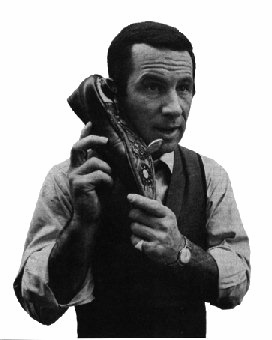
After reading all the articles and epitaphs in various publications recounting Don Adams' life and career, what he will inevitably be remembered for is his depiction of Maxwell Smart. I could not help but fondly remember what drew me to this TV spoof of the "secret agent" genre (ie. popularized at the time by Ian Fleming's creation). It was not the fact that it was written and conceived by Mel Brooks and Buck Henry, or that it won seven Emmys and two Golden Globe awards. What did draw me ( even as a child) back to this show time after time was the on-going gags and quips. Some of the most memorable:
- Max: (After causing yet another disaster for the Chief) "Sorry about that, Chief."
- Chief: "Now listen carefully ... [long list of directions to a secret rendezvous or some such] ... did you get that?" Max: "Not all of it." Chief: "Which part didn't you get?" Max: "The part after 'Now listen carefully'."
- Max: (Used when his enemies call his bluffs and he ineffectually resorts to more desperate ones) "Would you believe..."
- Max: "Missed it by that much."
- Max: "Don't tell me [he made yet another mistake and when his compatriot confirms it, he responds...] I asked you not to tell me that."
- Max: "The old...[complicated explanation]...trick" (often followed by "that's the second time this month")
- Chief/99/somebody else: "Max, you'll be in extreme danger every minute!" Max: "...and loving it!"
- Max: "That's the second biggest ...(whatever)... I've ever seen."
- Siegfried: (usually to silence his sidekick, Shtarker who is doing something silly) "Shtarker! Zis is KAOS, Ve don't... [whatever it was he was doing]... here!"
- Max: "Good thinking, 99." [Used by Max to congratulate 99 on a statement of the obvious as if she was learning deduction and logic from him. The implication was that she was just catching up to his thought processes, when in fact the expression on his face showed that he was embarrassed that he hadn't worked it out himself already.]
- "Hymie, kill the lights": Hymie the Robot (Dick Gauthier), a powerful android who tended to take orders too literally.
Friday, September 30, 2005

Tuesday, September 27, 2005
Gee! I Wonder if Anybody Will Read This?
Is Reading Dead? (Excerpt From - National CrossTalk (Winter 2005)
University-affiliated literary journals struggle to maintain funding as they compete for a shrinking audience
By Robert A. JonesLexington, Virginia
...The literary landscape has grown more perilous since the 1950s, a period that some regard as the golden era of literary magazines. During those post-World War Two years, a half dozen magazines-the Paris, Kenyon, Hudson and Southern reviews, among others-dominated the scene and garnered unto themselves most of the literary attention and financial support.
"At the time, those magazines could provide recognition and prestige to an author just by publishing a short story," said Rubin. "People would open their copies of the Southern Review or the Paris Review to see who had been anointed, so to speak. That's not true today. Literary magazines don't play that role."
They don't, in part, because reading itself plays a lesser role than it did in the '50s. A recent NEA study found that literary reading has undergone dramatic decline in the country, with less than half of American adults now reading any form of literature. That study led the Virginia Quarterly Review, published at the University of Virginia, to display on its website the drawing of a young woman, her head hung in despair and a manuscript dangling from her hand, with the caption, "Reading is Dead."
"In the 1950s we had an emerging middle class that saw literature and reading as one of the hallmarks of the educated person," said one editor. "That's not true today. Reading has lost its power to bestow status on the masses, and instead has become a cottage industry."
Perhaps so, but within that cottage industry another phenomenon is having a powerful effect on the world of literary magazines. Namely, the sheer number of literary journals is exploding even as readership has declined. Rather than the half dozen dominant journals of the '50s, about 20 major journals are now published around the country, all competing for attention and readers.
But those numbers are dwarfed by the proliferation of secondary journals that have popped up in cities and hamlets across the land. The Council of Literary Magazines and Presses estimates that the total number of literary journals in the country has hit 1,000, the highest number in history. Some exist solely online; others are published cheaply with desktop technology and may last only for one or two issues. But even as one journal dies, two others take its place.
In fact, it could be argued that the present time, and not the '50s, represents the real golden era for literary magazines. Bellevue Hospital in New York, for example, now publishes the Bellevue Literary Review. In Rochester, New York, a publication called Hazmat Review deals with poetry rather than noxious chemicals. Some journals publish only gay and lesbian literature; others accept only extra-long short stories; still others specialize in literature from certain neighborhoods in a given city.
What explains this burgeoning supply of literature in the midst of shrinking demand? Some veterans of the literary world believe the answer lies in the mushrooming culture of creative writing retreats and workshops that now churn out would-be writers by the thousands. The boom is occurring both inside universities and outside at institutions such as Breadloaf in Vermont.
"If you browse through Poets and Writers (the trade journal of creative writing) you will be amazed at the number of ads for these workshops," said Shannon Ravenel, editor and co-founder of Algonquin Books. "They're everywhere. And when you create writers, you also create readers of a particular sort. I'm talking about a crowd that wants to be published in a literary journal, and a crowd that is interested in what other writers are doing."
Another veteran sees the phenomenon more cynically. "Every writer needs an outlet," he said. "So you get tens of thousands of attendees at creative writing workshops looking for a journal to publish their one-and-only short story. If they can't find one, sometimes they simply create one to immortalize their work and their friends' work. In cases like this, the division between authors and readers is lost. Both sides are composed of the same people." ...
----------------------------------------------------------------------------
Complete Article: http://www.highereducation.org/crosstalk/ct0105/news0105-reading.shtml
Goodbye Chief!: 'Agent 86' Don Adams dies
Monday, September 26, 2005
Deja Vu All Over Again!
A PILGRIMAGE TO L'ORIGNAL
That he that is not busy being born
is busy dying.
------------------------------Bob Dylan
The last station to cross is the dirt road
that hits harder when the long drive
comes to a halt. You hate yourself
for begrudging her even this inconvenience.
The ranch house looks lost on the five-acres
of lawn that disappears into the undergrowth
and the bifocal eyes between the slats
of a shuttered window. "So you've come,"
a voice squeaks through the screen door
which reveals curator and medicus. She leads
you to a room with closed blinds; leaves
you with the changeling on the bed. You
could never have prepared for this.
The light tumbles into the room as you pull
up the blinds; turn to examine the face
of a homeless mind - translucent
and flaccid, blackened by pain.
She opens one good eye - greyer
than the clouds that spilt forgiveness
on you - and you are lost.
-------------------------------------------------------------------------------
Originally published in Thunder Sandwich 07/01/2003
Sunday, September 25, 2005
Friday, September 23, 2005

Tuesday, September 20, 2005




Monday, September 19, 2005
The Water-Closet Poet
Right now as I write this, I am sitting on my commode, holed up in my salle de bain. Outside the door, my daughters, impersonating the children from the “Lord of the Flies” are trying the knob with nutella-smeared fingers. The knob turns about like something out of a horror “B” flick: slowly and deliberately first counter-clockwise and then even more gingerly in the opposite direction. Then my gaolers speak - sotto voce, “Daddy are you in there?” A pause ensues and then the catch phrase, “We just want to wash our hands.” And I think to myself, ‘Awwww...no! I’m not gonna fall for that one again.’
The worst part of this scenario is that after the knob-turning stops, the scratching at the door ends, the wrapping with knuckles subsides and the voices desist I feel guilty… big time. I mean what kinda father am I anyway? (Rhetorical question - please do not answer.) My girls only want the attention of their father and as far as I know (unless the DNA tests I’ve ordered prove otherwise) that means me. Still I fight tooth and nail for “poetry breaks” and for some semblance of a writer’s studio in my study when my “Complete Works of Emily Dickinson” is not being used as a footrest when my eldest daughter is practicing her guitar.
I put my hands over my ears and keep repeating to myself in mantra-like fashion: “Poetry does not suck!” as a rebuttal to my youngest daughter’s assertions that who reads poetry and who writes this stuff anyway. I am a closet poet. Maybe that should be a new school in contemporary poetry. Certainly many of my poetic acquaintances do not freely admit that they read or “God forbid” write the stuff.
Then there’s my wife. “Dear,” I coo, “I’ve gotten an acceptance by a well known literary print magazine.”
“Oh, really.” she responds, “Is this a paying gig.”
“Well, yea! Sort of.” I counter.
“What do you mean sort of?” she queries.
“They pay me in copies of the issue of the journal and a one year subscription.”
“I see.... So that means we’ll have more poetry books in your study.”
At this point I retire to the WC again.
Thursday, September 15, 2005
Losing My Religion a la James Tate
A Knock On The Door
They ask me if I've ever thought
about the end of the world,
and I say, "Come in, come in,
let me give you some lunch, for God's sake."
After a few bites it's the afterlife
they want to talk about. "Ouch," I say,
"did you see that grape leaf skeletonizer?"
Then they're talking about redemption
and the chosen few sitting right by His side.
"Doing what?" I ask. "Just sitting?"
I am surrounded by burned up zombies.
"Let's have some lemon chiffon pie
I bought yesterday at the 3 Dog Bakery."
But they want to talk about my soul.
I'm getting drowsy and see butterflies
everywhere. "Would you gentlemen
like to take a nap, I know I would."
They stand and back away from me,
out the door, walking toward my neighbors,
a black cloud over their heads
and they see nothing without end.
From "Shroud of the Gnome" by James Tate © 1997
Saturday, September 10, 2005


Friday, September 09, 2005
Literary Quotes and Quotables For $1000
What is:
Most people ignore most poetry
because
most poetry ignores most people.
Adrian Mitchell
Most people ignore most poetry
because
most poetry ignores most people.
Adrian Mitchell
Saturday, September 03, 2005

Thursday, September 01, 2005
Rereading Moore
Poetry
Marianne Moore
I, too, dislike it: there are things that are important beyond
-------all this fiddle.
---Reading it, however, with a perfect contempt for it, one
-------discovers in
--- it after all, a place for the genuine.
-------Hands that can grasp, eyes
-------that can dilate, hair that can rise
---------- if it must, these things are important not because a
high-sounding interpretation can be put upon them but because
-------they are
--- useful. When they become so derivative as to become
-------unintelligible,
--- the same thing may be said for all of us, that we
------- do not admire what
------- we cannot understand: the bat
-----------holding on upside down or in quest of something to
eat, elephants pushing, a wild horse taking a roll, a tireless
--------wolf under
--- a tree, the immovable critic twitching his skin like a horse
--------that feels a flea, the base-
---ball fan, the statistician--
--------nor is it valid
------------to discriminate against "business documents and
school-books"; all these phenomena are important. One must make
-------a distinction
---however: when dragged into prominence by half poets, the
-------result is not poetry,
--- nor till the poets among us can be
-------"literalists of
-------the imagination"--above
------------insolence and triviality and can present
for inspection, "imaginary gardens with real toads in them,"
--------shall we have
---it. In the meantime, if you demand on the one hand,
---the raw material of poetry in
--------all its rawness and
--------that which is on the other hand
------------genuine, you are interested in poetry.
Subscribe to:
Posts (Atom)