Friday, September 30, 2005

Nevermind!!!


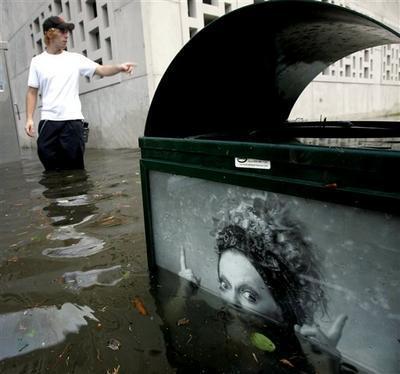
Why aid was slow in getting to New Orleans!
Tuesday, September 27, 2005

Gee! I Wonder if Anybody Will Read This?

Is Reading Dead? (Excerpt From - National CrossTalk (Winter 2005)

University-affiliated literary journals struggle to maintain funding as they compete for a shrinking audience
By Robert A. JonesLexington, Virginia

...The literary landscape has grown more perilous since the 1950s, a period that some regard as the golden era of literary magazines. During those post-World War Two years, a half dozen magazines-the Paris, Kenyon, Hudson and Southern reviews, among others-dominated the scene and garnered unto themselves most of the literary attention and financial support.

"At the time, those magazines could provide recognition and prestige to an author just by publishing a short story," said Rubin. "People would open their copies of the Southern Review or the Paris Review to see who had been anointed, so to speak. That's not true today. Literary magazines don't play that role."

They don't, in part, because reading itself plays a lesser role than it did in the '50s. A recent NEA study found that literary reading has undergone dramatic decline in the country, with less than half of American adults now reading any form of literature. That study led the Virginia Quarterly Review, published at the University of Virginia, to display on its website the drawing of a young woman, her head hung in despair and a manuscript dangling from her hand, with the caption, "Reading is Dead."

"In the 1950s we had an emerging middle class that saw literature and reading as one of the hallmarks of the educated person," said one editor. "That's not true today. Reading has lost its power to bestow status on the masses, and instead has become a cottage industry."

Perhaps so, but within that cottage industry another phenomenon is having a powerful effect on the world of literary magazines. Namely, the sheer number of literary journals is exploding even as readership has declined. Rather than the half dozen dominant journals of the '50s, about 20 major journals are now published around the country, all competing for attention and readers.

But those numbers are dwarfed by the proliferation of secondary journals that have popped up in cities and hamlets across the land. The Council of Literary Magazines and Presses estimates that the total number of literary journals in the country has hit 1,000, the highest number in history. Some exist solely online; others are published cheaply with desktop technology and may last only for one or two issues. But even as one journal dies, two others take its place.

In fact, it could be argued that the present time, and not the '50s, represents the real golden era for literary magazines. Bellevue Hospital in New York, for example, now publishes the Bellevue Literary Review. In Rochester, New York, a publication called Hazmat Review deals with poetry rather than noxious chemicals. Some journals publish only gay and lesbian literature; others accept only extra-long short stories; still others specialize in literature from certain neighborhoods in a given city.

What explains this burgeoning supply of literature in the midst of shrinking demand? Some veterans of the literary world believe the answer lies in the mushrooming culture of creative writing retreats and workshops that now churn out would-be writers by the thousands. The boom is occurring both inside universities and outside at institutions such as Breadloaf in Vermont.

"If you browse through Poets and Writers (the trade journal of creative writing) you will be amazed at the number of ads for these workshops," said Shannon Ravenel, editor and co-founder of Algonquin Books. "They're everywhere. And when you create writers, you also create readers of a particular sort. I'm talking about a crowd that wants to be published in a literary journal, and a crowd that is interested in what other writers are doing."

Another veteran sees the phenomenon more cynically. "Every writer needs an outlet," he said. "So you get tens of thousands of attendees at creative writing workshops looking for a journal to publish their one-and-only short story. If they can't find one, sometimes they simply create one to immortalize their work and their friends' work. In cases like this, the division between authors and readers is lost. Both sides are composed of the same people." ...

----------------------------------------------------------------------------
Complete Article: http://www.highereducation.org/crosstalk/ct0105/news0105-reading.shtml

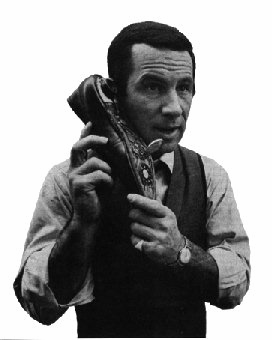
Goodbye Chief!: 'Agent 86' Don Adams dies

Actor and comedian Don Adams, best known for his role as clumsy secret agent Maxwell Smart in the 1960s television comedy Get Smart, has died. Aged 82, he died of a lung infection.


"Hymie, kill the lights"

Monday, September 26, 2005

Deja Vu All Over Again!

A PILGRIMAGE TO L'ORIGNAL

That he that is not busy being born
is busy dying.
------------------------------Bob Dylan


The last station to cross is the dirt road
that hits harder when the long drive
comes to a halt. You hate yourself
for begrudging her even this inconvenience.

The ranch house looks lost on the five-acres
of lawn that disappears into the undergrowth
and the bifocal eyes between the slats
of a shuttered window. "So you've come,"

a voice squeaks through the screen door
which reveals curator and medicus. She leads
you to a room with closed blinds; leaves
you with the changeling on the bed. You
could never have prepared for this.

The light tumbles into the room as you pull
up the blinds; turn to examine the face
of a homeless mind - translucent
and flaccid, blackened by pain.

She opens one good eye - greyer
than the clouds that spilt forgiveness
on you - and you are lost.


-------------------------------------------------------------------------------
Originally published in Thunder Sandwich 07/01/2003

Friday, September 23, 2005

Tuesday, September 20, 2005

Monday, September 19, 2005

The Water-Closet Poet

Right now as I write this, I am sitting on my commode, holed up in my salle de bain. Outside the door, my daughters, impersonating the children from the “Lord of the Flies” are trying the knob with nutella-smeared fingers. The knob turns about like something out of a horror “B” flick: slowly and deliberately first counter-clockwise and then even more gingerly in the opposite direction. Then my gaolers speak - sotto voce, “Daddy are you in there?” A pause ensues and then the catch phrase, “We just want to wash our hands.” And I think to myself, ‘Awwww...no! I’m not gonna fall for that one again.’

The worst part of this scenario is that after the knob-turning stops, the scratching at the door ends, the wrapping with knuckles subsides and the voices desist I feel guilty… big time. I mean what kinda father am I anyway? (Rhetorical question - please do not answer.) My girls only want the attention of their father and as far as I know (unless the DNA tests I’ve ordered prove otherwise) that means me. Still I fight tooth and nail for “poetry breaks” and for some semblance of a writer’s studio in my study when my “Complete Works of Emily Dickinson” is not being used as a footrest when my eldest daughter is practicing her guitar.

I put my hands over my ears and keep repeating to myself in mantra-like fashion: “Poetry does not suck!” as a rebuttal to my youngest daughter’s assertions that who reads poetry and who writes this stuff anyway. I am a closet poet. Maybe that should be a new school in contemporary poetry. Certainly many of my poetic acquaintances do not freely admit that they read or “God forbid” write the stuff.

Then there’s my wife. “Dear,” I coo, “I’ve gotten an acceptance by a well known literary print magazine.”
“Oh, really.” she responds, “Is this a paying gig.”
“Well, yea! Sort of.” I counter.
“What do you mean sort of?” she queries.
“They pay me in copies of the issue of the journal and a one year subscription.”
“I see.... So that means we’ll have more poetry books in your study.”

At this point I retire to the WC again.

Thursday, September 15, 2005

Losing My Religion a la James Tate

A Knock On The Door

They ask me if I've ever thought
about the end of the world,
and I say, "Come in, come in,
let me give you some lunch, for God's sake."
After a few bites it's the afterlife
they want to talk about. "Ouch," I say,
"did you see that grape leaf skeletonizer?"
Then they're talking about redemption
and the chosen few sitting right by His side.
"Doing what?" I ask. "Just sitting?"
I am surrounded by burned up zombies.
"Let's have some lemon chiffon pie
I bought yesterday at the 3 Dog Bakery."
But they want to talk about my soul.
I'm getting drowsy and see butterflies
everywhere. "Would you gentlemen
like to take a nap, I know I would."
They stand and back away from me,
out the door, walking toward my neighbors,
a black cloud over their heads
and they see nothing without end.


From "Shroud of the Gnome" by James Tate © 1997

Saturday, September 10, 2005

Well-Read.

"The reader", © 2002. - Maggie Taylor

Somebody Shut That Window!

"Poet's House" © 1999 - Maggie Taylor

Friday, September 09, 2005

Literary Quotes and Quotables For $1000

What is:

Most people ignore most poetry
because
most poetry ignores most people.

Adrian Mitchell

Saturday, September 03, 2005

Thursday, September 01, 2005

Rereading Moore

Poetry
Marianne Moore

I, too, dislike it: there are things that are important beyond
-------all this fiddle.
---Reading it, however, with a perfect contempt for it, one
-------discovers in
--- it after all, a place for the genuine.
-------Hands that can grasp, eyes
-------that can dilate, hair that can rise
---------- if it must, these things are important not because a

high-sounding interpretation can be put upon them but because
-------they are
--- useful. When they become so derivative as to become
-------unintelligible,
--- the same thing may be said for all of us, that we
------- do not admire what
------- we cannot understand: the bat
-----------holding on upside down or in quest of something to

eat, elephants pushing, a wild horse taking a roll, a tireless
--------wolf under
--- a tree, the immovable critic twitching his skin like a horse
--------that feels a flea, the base-
---ball fan, the statistician--
--------nor is it valid
------------to discriminate against "business documents and

school-books"; all these phenomena are important. One must make
-------a distinction
---however: when dragged into prominence by half poets, the
-------result is not poetry,
--- nor till the poets among us can be
-------"literalists of
-------the imagination"--above
------------insolence and triviality and can present

for inspection, "imaginary gardens with real toads in them,"
--------shall we have
---it. In the meantime, if you demand on the one hand,
---the raw material of poetry in
--------all its rawness and
--------that which is on the other hand
------------genuine, you are interested in poetry.

Wednesday, August 31, 2005

The Unspeakable


My prayers go out to all the victims of Katrina. In order to donate: http://www.networkforgood.org/topics/animal_environ/hurricanes/

Tuesday, August 30, 2005

The Sum of All Its Parts.

As I put together my submissions of poetry I consider the fashion in which I combine my poems. I attempt to group them into a cluster, which are somehow interconnected on one level or another. (Madness needs method or some such!) It stands to reason that not all poems are created equal, even when they are penned by the same hand (and especially when they are penned by this particular hand). There is bound to be a poem in an ensemble of poesy that is more persuasive; is more convincing; teaches; impresses or goads the reader more effectively into the implied rhetoric of the speaker.

So therein lies the quandary, how do we arrange our poetic fruit? Do we put the freshest up front so as to cajole the reader into sniffing it? Do we entice the reader with an hors d'oeuvre of verse? Or do we just bear it all and lay it on the line in a WYSIWYG display? This leads me to a second question: Is the relative value of a submission only as good as the best poem in the lot or as bad as the worst poem in the clique?

As the pomes in question lay before me, they implore me to choose them: much like the last few kids in the high school gym that are waiting to be redeemed by the team captains when picking sides. When it comes to the very last sheet of verse to be picked, it is no selection at all is it? I cannot help but hear an audible sigh!

Sunday, August 28, 2005

Drapeau De Montreal.


The four symbols are a fleur-de-lys for the French, a rose for the English, a shamrock for the Irish and a thistle for the Scottish. (What about the Italians? Well we got here a little too late I guess or maybe they just ran out of space. ) The cross has a religious connotation, though you may come across different interpretations from various sources.

Friday, August 26, 2005

The Stamps Just Arrived & Now I Have no Reason Not to Send Out Submissions


PULITZER WINNER ROBERT PENN WARREN ON U.S. POSTAGE STAMP -

Poet, novelist and educator Robert Penn Warren was honored in 2005 by the U.S. Postal Service with the issuance of a commemorative postage stamp. Robert Penn Warren was America's first official poet laureate (1986-87) and a three-time recipient of the Pulitzer Prize, the only writer to have won the prize in poetry ("Promises: Poems, 1954-1956," in 1958, and "Now and Then: Poems, 1976-1978," in 1979) as well as fiction ("All the King's Men," 1947). Warren received scores of other awards as well, including the Presidential Medal of Freedom (1980). He died on September 15, 1989, in West Wardsboro, VT. Artist Will Wilson of San Francisco, CA, based his portrait of Warren on a 1948 photograph obtained from the Center for Robert Penn Warren Studies at Western Kentucky University. The background art recalls scenes from "All the King's Men." The stamp is 21st in the Literary Arts series, which also includes Zora Neale Hurston (2003), Ayn Rand (1999) and Stephen Vincent Benét (1998).


San Francisco Night Windows

So hangs the hour like fruit fullblown and sweet,
Our strict and desperate avatar,
Despite that antique westward gulls lament
Over enormous waters which retreat
Weary unto the white and sensual star.
Accept these images for what they are--
Out of the past a fragile element
Of substance into accident.
I would speak honestly and of a full heart;
I would speak surely for the tale is short,
And the soul's remorseless catalogue
Assumes its quick and piteous sum.
Think you, hungry is the city in the fog
Where now the darkened piles resume
Their framed and frozen prayer
Articulate and shafted in the stone
Against the void and absolute air.
If so the frantic breath could be forgiven,
And the deep blood subdued before it is gone
In a savage paternoster to the stone,
Then might we all be shriven.


From Selected Poems of Robert Penn Warren, edited by John Burt. Copyright © 2001 by John Burt.

Saturday, August 20, 2005

The Submission Wars

Took a couple of casualties what with Kenyon Review and Gargoyle giving me the horizontal nod. However, I just started to sub this batch of three poems and therefore, I have not precluded the possibility of getting a print journal to publish at least one of them. Kenyon’s editors took five months to shrug their shoulders. I guess that’s a good sign. I am, however, wary of their invitation to think of them in future as I did receive a "form" response. (But heck that hasn't stopped me before from resubbing to a magazine.) My last batch of poems went out to eight journals and one of the poems was picked up by Shenandoah so I still count myself lucky.

I have been unable to send out any poems out by snail mail as my American SASE postage had run out. (International postage purchased at a Canadian post office is way too costly; setting me back over five dollars each time I sent out a SASE.) The last time I got some American stamps they were provided by some friends who were heading south. I did some checking and “lo and behold”, postage can be bought on-line from the United States Postal Service: http://www.usps.com/shop . So I guess I’m back in business.

I am a notoriously unprolific poet and barely have time to scribble a couple of lines down these days before I am unceremoniously torn away from my muse. This does not sit well with my muse who has been drinking my Valpolicella and eating my Parmeggiano Reggiano. What can I say my muse has impeccable taste. However, I do now have enough material for about three sets of submission batches. So wish me luck as I assault the bastions of the literary world.

Thursday, August 18, 2005

Mal Occhio


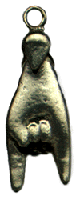
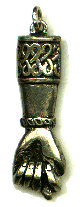
Italians are very superstitious people. They believe in the"Mal Occhio" or evil eye: "The evil eye belief is that a person -- otherwise not malific in any way -- can harm you, your children, your livestock, or your fruit trees, by *looking at them* with envy and praising them. The word "evil" is unfortunate in this context because it implies that someone has "cursed" the victim, but such is not the case. A better understanding of the term "evil eye" is gained if you know that the old British and Scottish word for it is "overlooking," which implies merely that the gaze has remained too long upon the coveted object, person, or animal. In other words, the effect of the evil eye is misfortunate, but the person who harbours jealousy and gives the evil eye is not necessarily an evil person per se. To ward off the "evil eye" the Italian typically involves: "... making the gestures called the mano fico ("fig hand") and the mano cornuto ("horned hand").


Mano cornuto is a gesture in which the middle and ring fingers are held down by the thumb and the index and little fingers are extended outward like horns. Among some people this is the sign of a cuckholded man, but it is also widely used as a protective gesture against impotency. The mano cornuto is familiar to Americans who read comic books as the gesture Dr. Strange makes when he casts a spell and the gesture Spider-Man makes when he "thwips" web fluid from his wrists. (The popular artist Steve Ditko was responsible for the design of both of these characters, and some comic fans refer to the mano cornuto as "the Steve Ditko hand gesture.") Mano fico is a hand gesture in which the thumb is inserted between the index and middle finger. It means literally means "fig hand" in Italian, but "fica" or fig is a common slang term for the female genitals, so the mano fico is a representation of the sex act (with the thumb as phallus)."

Another common response to "ward off" the "evil eye" is for the male Italian to touch his testicles; I suppose for the reassurance that they're still there. When I was a kid I thought that all baseball players must be Italian.

-------------------------------------------------------------

For a futher discussion on "superstition" check out Justin Evans blog: http://utahpoet.blogspot.com/