Monday, January 02, 2006

The Way I Feel After Two Nights of Revelry


"Strange Beast" - Maggie Taylor circa 2003

Saturday, December 31, 2005

For Auld Lang Syne!


"Le Bal Mabile" : Jean Beraud - Oil on panel 5 5/8 x 9 1/4 inches (14.3 x 23.5 cm)

Make with the merry! Happy New Year!

Thursday, December 29, 2005

Strange Bedfellows: The Terms "Sociology" & "Poetry"

“In a nutshell, sociology is the scientific study of the human being as he/she relates with other human beings. Recognizing that humans are social beings who never naturally live in isolation, sociologists analyze them not as individuals but in their natural habitat – groups of various kinds. Thus sociology is the study of humans in groups. Other definitions, shorter and at a higher level of abstraction…For instance sociology is often defined as the science of human interaction, the study of human relationships, or the science of social action systems. But all definitions revolve around the goals of sociology: the discovery of facts, their explanation, and their role in predicting human behavior as it occurs among humans in association with other humans.” (Perry & Perry: “The Social Web”, Harper and Row, 1973)

Sociology is a relatively young discipline, although it has a long tradition behind it. It didn’t even acquire a name until the latter part of the nineteenth century. (Compare that to philosophy for example.) Furthermore it has only been in the last four or five decades that many universities have even established separate sociology departments. Many of its critics in the past have maintained that sociology is an impossible endeavor because it attempts to conduct scientific studies of human interaction in an uncontrollable environment and thus not all variables can be identified or accounted for in the formulation of any theories forwarded to explain any social phenomena.

Sociology is definitely not exotic, distant or even abstract and sociologists contend that it is not necessary to put social phenomena under a microscope to observe, dissect or to better understand them. The problem is that it does not usually occur to people that everyday social behavior even need be scrutinized. But thankfully it does to sociologists.

However, poetry is not by definition, necessarily a social endeavor. That is to say poetry, as a creative process, need not take place within the confines of a social milieu. (I.e. workshop/ classroom/ social gathering… etcetera). Even the etiology of the word poetry (ancient Greek: ποιεω (poieo) = I create) intimates that it is intended as a solitary human behavior. Albeit its social manifestations, poetry ( in and of itself) cannot with all honesty be bandied about as social phenomenon. (Although, possibily as a product of social activity.)

The poet and his or her social interactions and affiliations etc.... are another case in point. The latter are indeed fodder for sociological research. Furthermore, a study of how poets interact within or beyond the confines of a poetic community has not to my knowledge been exhausted. Another possibility might involve the social study of (would-be) poets in an institutional setting in contrast to poets who have not subscribed to the same or any educational socialization might also prove to be an insightful approach and/or analogy to undertake.

There might even be a cross-cultural quantitative study of the social characteristics of the poets published in “respected” poetry publications. The results of this test might be cross-referenced with the social makeup of the respective editorial staff of these said publications. How are the two correlated? The possible subject matter pertaining to the “poet’s” social milieu, that might be explored via sociological theory and investigation is limited only by the sociologist’s cognitive mindset ( and knowledge of the poetic social milieu).

However, to simply state that the poetic world is chaotic (even if accurate) does not take us any closer to the true nature of the beast. But even if this assertion is valid, we cannot with any certainty conclude that it is poetry - per se - that is chaotic. It is more likely that it is the world that the poet navigates and negotiates that is chaos. This world is not solely inhabited by poets at all.

-----------------------------------------------------------------------
1. (The Greek verb ποιέω [poiéō (= I make or create)], gave rise to three words: ποιητής [poiētḗs (= the one who creates)], ποίησις [poíēsis (= the act of creation)] and ποίημα [poíēma (= the thing created)]. From these we get three English words: poet (the creator), poesy (the creation) and poem (the created).)

Saturday, December 24, 2005

Friday, December 23, 2005

Sunday, December 18, 2005

Let it Snow


Jean Beraud - "Women Skating"
Oil on panel - 15 5/8 x 12 5/8 inches (40 x 32.3 cm)

Saturday, December 17, 2005

Thought For The Day


If we can have - "Full Contact Fishing", then why can't we have - "Full Contact Poetry"?

------------------------------------------------------------------------------------
Postscript: I just googled "Full Contact Poetry" and came up with this:

http://web.media.mit.edu/~anindita/fullcontactpoetry.PDF


"Full-Contact Poetry is a digital play space for children's poetic expression. It is a software environment in which children can express their poetic thoughts, create their interpretations of writing by others and also share these expressions. The environment combines ideas from literary theory and analysis with constructionism to extend tools for poetic expression. Children can experience poetry by playing with words as objects, experimenting with typographic effects, moving words through space and navigating into and through the text, while also being able to incorporate and reconfigure sound and image. "

--------------------------------------------------------------------Anindita Basu


A fine premise for a thesis, but not exactly what I had in mind.

An Informal Survey of Sorts

The inclusion of music clips has been more successful an addition to my blog than I might have predicted. The four clips have been accessed a total of 130 times. Here's a breakdown:

Song Title-------------------------Accessed-----Percent

Werewolves of London - Warren Zevon--------------32----------------24.6%
Strawberry Fields Forever - John Lennon-------------26----------------20.0%
I am a Rock - Simon & Garfunkel---------------------42----------------32.3%
Riders On The Storm - The Doors---------------------30----------------23.1%

Total ---------------------------------------------------130----------------100%


*Of course there is no way to determine how many times any one reader may have accessed a song. For all I know it might just be one person that accessed "I am a Rock" by Simon & Garfunkel 42 times.


I'm not quite sure what that says about my readers per se. Maybe it's par for the course. After all, I assume that my readers are mostly poets and aren't we supposed to be practising a quiet and sullen art (ergo the choice?). Any other theories will be gladly considered.

Thursday, December 15, 2005

Shenandoah Vol. 55 Number 3: Another Julie Speed Cover


"Woman With Cherries", oil on linen 24" x 24"
2003-2004


This issue includes poetry by:

Brendan Galvin, Maxine Kumin, Elton Glaser, Chi Lam, Tim McBride, Priscilla Atkins, Sara Johnson, Yu Xuanji, Daniel Mark Epstein, Rick Bass, Jay Rogoff, Deborah Bogen, Lynn Strongin, Melissa Morphew, Jim Leininger, Roy Jacobstein & John Engels.

It also includes the winner of the Robert Penn Warren Centennial Prize: Lucy Ferriss, " Robert Penn Warren and Psychological Pastoralism".

In addition to her cover art. This issue includes a portfolio of six of Julie Speed's paintings.

Tuesday, December 13, 2005

Marital Bliss


Marriage
by Linda Pastan

He is always turning the radio on,
or the stereo, or the TV news,
and she is always shouting at him
through the noise to turn them off.

It's the kind of thing that should be settled
before marriage, the way prospective
college roommates must say whether they smoke.
But they've been together for years,

and he still fills his head with facts
and music (arias, average rainfalls,
the temperament of the nation) as if
he's saving them up for something.

She says it's like living with a flock
of angry crows, squawking and rattling
their wings inside the house.
She wants her head to be filled

with silence, with empty space
for tranquility to enter. There are times
when their life is a dance they perform
around each other, trying not to collide.

"Move the way a violin would sound,"
a real dancer said. He puts on her favorite
CD, the Brahms Intermezzo.
Sometimes even crows are happy.


---------------------------------------------------
from Shenandoah Vol. 55 No. 2

Sunday, December 11, 2005

Tuesday, December 06, 2005

The Long and Whining Road.

Nick needs some TLC.
Nick needs a friend.
Nick needs someone to cheer him up.
Nick needs a friend. (at least another one)

Nick needs to get in touch with his daughter.
Nick needs to express deep emotions that he finds hard to convey,
Nick needs to shut his piehole.
Nick needs his butt kicked clear on out of his mouth.

Nick needs his hair dyed.
Nick needs sleep
Nick needs to lay off the absinthe.
Nick needs a bottle to pee in

Nick needs a critique
Nick needs to get a handle on his work ethic
Nick needs to get his $hit together and start putting his own stuff out,
Nick needs Ex-Lax
Nick needs to prune his ideas down to those that are related to "our Universe".

Nick needs a bottle to pee in. (one bottle wasn't enough)
Nick needs a place to stay.
Nick needs to move on.
Nick needs constant supervision.
NICK NEEDS MEDS

Monday, December 05, 2005

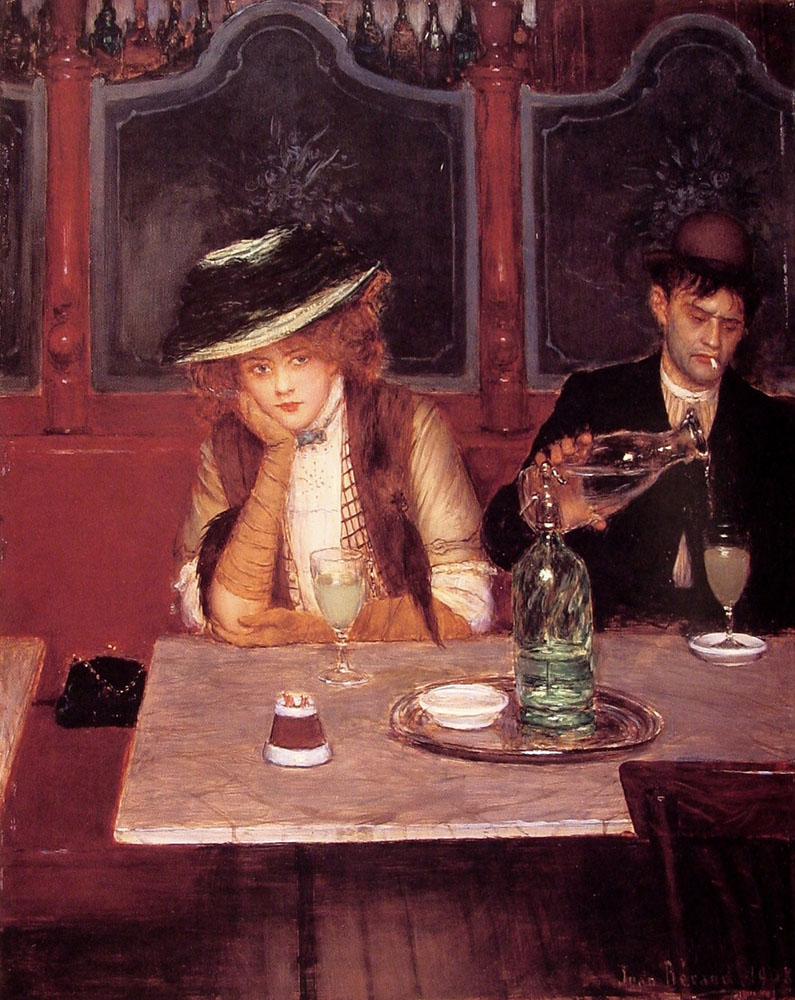
Le Cercle D'Ennui


Jean Béraud : The Drinkers, 1908 - Oil on panel

Tuesday, November 29, 2005

Back By Popular Demand


Poetry & Self-Identification


One of the perks of being a graduate student was a valid justification for keeping odd hours. All night vigils were common as I waited for an unaccustomed silence to give me respite from "dumbfoundry". Pulling all-nighters in search of a thesis, as though somehow the archetypal stream of consciousness was freer in the wee hours of the morning, was a common occurrence. Inevitably, the next day’s start would be delayed and often graduate tutorials were scheduled as late afternoon classes so as to accommodate both my professors and myself. My mind was never sharp in the mornings anyway. A very good argument might of course also have been made for bouts of afternoon obtuseness.

My afternoon starts meant that my departure toward a downtown university campus coincided with my father’s return from work. As I walked out the door I could see him making his way down the left side of the street. Sometimes he would emit a soft but audible whistle as I crossed the road in a huff hurrying toward the bus stop so that I might make my tutorial on time. But no matter how I cloaked it in that rationalization, it was a clear attempt at avoidance. The truth lay more in the fact that I was so preoccupied with breaking out of a “working class” mold that I even tried to physically avoid my working class origins.


------------------------------------------II


Kathy Lou Schultz seems on the money when positing that with respect to university, “not everyone enters such a program with equal amounts of privilege and completing a degree while providing for the acquisition of particular cultural capital is not a great leveler.” (1) Albeit, education is mistakenly seen by the working class as a “way out” of the quagmire of this caste. But sometimes it’s more like owning a tuxedo with no place to go. Or as Schultz describes her own sense of marginality: “Amphibious, we live in both worlds, but belong to neither.” (2) And though we are indistinguishable from the “genuine” article in a Zelig type fashion we are always wary that we might be found out. We fret that “they” might see through us and realize that we really are vapid and uncultivated because we secretly prefer the Doors to DeBussy.

Still we want to be part of an intellectual community and/or a writer’s community. Wanting to be a poet only exacerbates the dichotomy as poetry and working class ethics seem to be diametrically opposed. There is little room for the quiet contemplation that is necessary to foster a rapport with the poem in the survivalist mentality which pervades the working class experience. Parents inevitably want their children to attain degrees that tout their professionalism to relative and neighbor alike. For my efforts I have a B.A. in Anthropology/ minor in Sociology and a M.A. in Sociology. My father still, to this day, doesn’t know quite why he sent me to university for and how to describe my educational achievements to significant others.And no, he doesn’t quite know what to make of my poetry either!


-----------------------------------------------------------------------

1&2 from "Talking Trash, Talking Class: What's a Working Class Poetic, and Where Would I Find One?" by Kathy Lou Schultz . This essay first appeared in tripwire: a journal of poetics, no. 1, Spring, 1998.

Saturday, November 26, 2005

Wednesday, November 16, 2005

Monday, November 14, 2005

KEVIN PILKINGTON


PARTHENON


When you arrived in Athens
you discovered the Acropolis
was never named after a diner
down on Second Avenue and
the Parthenon could never fit in
your hand the way it always did
with coffee to go in a paper cup.
Your hotel was just blocks away.
At night you sat on the roof staring
at the ancient ruin, lights shining
on it—lit up like an old man
on good wine.

The next day you toured the Acropolis
so amazed you kept taking photos
of the Berilie gates, a few
columns, next the east cella, another
of a blonde in tight shorts. You pick
up a stone to put in your pocket
as a souvenir and to weigh you
down against the wind that kept
knocking your cap off like a bully
from the grammar school near plaka.
Below the east pediment stronger
gusts blow dust off the ground
spinning it into a statue of Athena
who stares into your face until
another gust blows her way.

In the Acropolis museum
a young statue of a sixth century
boy holds onto a calf that is
draped over his shoulders like
a sweater. You admire him since
you were never able to hold onto
anything for that long in your life.
Near him is a maiden with the kind
of curves in her stone you couldn't help
noticing. Even with her hands missing
along with a bit of nose, she still
looks hot and hasn't put on an ounce
of marble around the hips for centuries.

Outside you look down at Athens
that in the distance under the bright sun
looks like a path made of white pebbles
and beyond it the sea. You decide
to go for a swim and now
that you are convinced it takes more
than one god to run a universe,
you are able to jump up on a wall,
step down on rooftops and stroll
all the way to the Aegean.


© by Kevin Pilkington


------------------------------------------------------------
VALPARAISO POETRY REVIEW: Fall/Winter 2005-2006

Tuesday, November 08, 2005

Revenge of The Herniated Disc. (Or how one bad disc corrupted the vertebral neighborhood.)

During the past decade or so I have battled with bouts of "sore backs" that have kept me inactive for weeks at a time, but never pain like this. This time, I’m in pain with a capital “P”. And no, it’s not emotional or spiritual or even creative in nature. (Although I could do with a little of the latter I guess – strife being good for the creative juices and all…) This is a throbbing, pulsating waterfall of pain emanating from my lumbar region [L4-L5 to be precise]; down my left leg ensconcing itself in my left foot. This is the pain, I surmise, that they must have been imagining when they coined the idiomatic expression: “Hitting a raw nerve.”

Thirteen years ago; (and no (even now) I do not suffer from “triskaidekaphobia” actually it’s a lucky number in an Italian’s book.), I was diagnosed with a herniated disk [L2-L3] and had a diskectomy to rectify the situation. My experience in hospital at the Montreal Neurological Institute had impressed on me how much the quality of one life may vary from another. Watching patients in glass-walled cubicles as they were constantly monitored by staff for any aberrant behavior lent a surreal, almost Orwellian tinge to the experience. The patient that affected me the most was a woman who in preparation for her surgery (I logically assumed: for a brain tumor) had had her head shaved and her scalp mapped out into quadrants (for obvious surgical purposes) much like something from a Clive Barker movie. The upshot being that Alighieri had it wrong: Heaven, Hell and Purgatory can all concomitantly exist – sometimes even in the same room.


Note: Thanks to those that e-mailed me to inquire as to why I had not been posting as often as “usual” whatever that is. I’m glad you noticed. Mille grazie.

Saturday, November 05, 2005