Tuesday, January 10, 2006

Who's Baiting Who


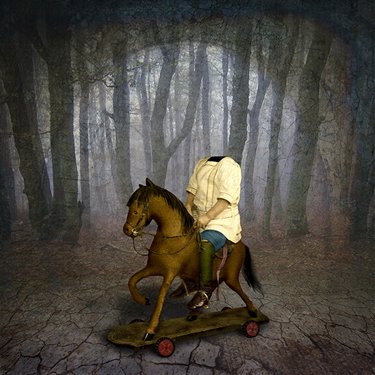
"Not Yet" - Maggie Taylor - 1998


"Maybe Never" - Maggie Taylor - 1998

Sunday, January 08, 2006

Just Found Out About This New Journal


About the Review:

The Saranac Review was born in 2004 out of four writers' vision to open a space for the celebration of many voices including those from Canada. Attempting to act as a source of connection, the journal publishes the work of emerging and established writers from both countries. As our mission states, "The Saranac Review is committed to dissolving boundaries of all kinds, seeking to publish a diverse array of emerging and established writers from Canada and the United States.

"The Saranac Review aims to be a textual clearing in which a space is opened for cross-pollination between American and Canadian writers. In that way, we aim to be a textual river reflecting diverse voices, a literal "cluster of stars," an illumination of the Iroquois roots of our namesake, the word, Saranac. We believe in a vision of shared governance, of connection, and in the power of art.

In the inaugural issue of The Saranac Review:

Naomi Ayala/Wesley Brown/Rick Campbell/Ioan Flora (trs. Adam Sorkin)/Indira Ganesan/Amy Gerstler/Honoree Jeffers/Rustin Larson /Robert Long/David Albahari/Tony Medina/E.Ethelbert Miller/William Olson/Jay Parini/Elizabeth Powell/Don Revell/Neil Shephard

Saturday, January 07, 2006

Denise Duhamel


MY FIRST BOOK OF POETRY WAS LIKE MY FIRST BABY

since I don't plan to have children. I wanted people to love it
and make a fuss, and, in turn, tell me what a great job I'd done.
My book wasn't reviewed in that many places, and when it was,
one reviewer even called it sloppy. The grandparents weren't as doting
as I'd expected. They went on with their own lives
and didn't buy the book any presents. No one took a picture of me
holding the book in my lap. My husband wasn't jealous
that I was spending too much time with the book. My dog
sniffed the book and walked away, unthreatened. Other books
were getting cooed and fussed over, books cuter and more enchanting than mine.
There is no greater pain for a mother--seeing her child left out. Soon I knew
I had a book that would never accomplish much with its life,
that it wouldn't win prizes or be displayed in prestigious bookstores.
That my book would probably be a drop-out, that I'd have nothing
to brag about when my cousins showed me graduation pictures of their kids.
That my book wouldn't buy me dinner or take care of me
when I grew old. I tried not to let the book sense my disappointment.
I tried to love it for the book that it was, but it began to have the telltale signs
of depression, hanging out with the wrong crowd,
dressing like a rebel. The book reminded me of myself as a teenager,
but when I told it that it shivered in disgust, blaming me
for bringing it into this world in the first place.

----------------------------------------------------------------
From - R o c k S a l t P l u m R e v i e w Anniversary Issue: Winter 2005
- Originally published in Gargoyle magazine, 1995.

Thursday, January 05, 2006

Poet Irving Layton Dies in Montreal at Age 93

(1912-2006)

“When I first clapped eyes on the poems of Irving Layton I let out a yell of joy… for the way he greeted the world he was celebrating, head up, eyes propped wide.… He inhabits the medium [of poetry] and is at home in it, passionately.… With his vigor and abilities, who shall not say that Canada will not have produced one of the west’s most famous poets?”–

William Carlos Williams

“...And, at last, both famous and good

I'm a Doge, a dog

At the end of a terrace

Where poems like angels like flakes of powder

Quaver above my prickling skin."

Composition in Late Spring, Selected Poems 1945-89 A Wild Peculiar Joy, M&S: 1989

Wednesday, January 04, 2006

Doppelganger

Over at Kelli's I found the website for Face Recognition . So I subjected my mug and got this match as one of the results. Funny thing about this match is that Yukio Mishima's - "The Temple of the Golden Pavillion" has had an enduring effect on me even after all the years since I read it back in college. I'm not sure of any resemblance, however, either physical or creative. Still, I'm flattered to say the least.


Tuesday, January 03, 2006

Ploughshares: Winter 2005-2006

Last Class
by David Lehman

Thus what we’ve learned is that
our greatest poets were death-obsessed loners
who seldom enjoyed the pleasures of lovers
despite living in a constant state

of sexual excitation. They started as revolutionaries
and atheists, or they went to Harvard
and voted Republican and mowed the yard.
The night sky was starry and told them stories.

Many didn’t drive. They walked to work,
writing poems in their heads, or stayed
in their rooms, stayed out of trouble, prayed
to a god no longer believed in. They felt like jerks

in company, not knowing how to behave.
They masturbated a lot, grew expert
in solitude, pain, the power of a primal hurt
and a witty epitaph on a well-kept grave.


Copyright © David Lehman

Warning: This Post Contains Objectionable Material To Individuals Who Live Below, Above or are Wearing a Bible Belt.


A MORNING PRAYER

Monday, January 02, 2006

The Way I Feel After Two Nights of Revelry


"Strange Beast" - Maggie Taylor circa 2003

Saturday, December 31, 2005

For Auld Lang Syne!


"Le Bal Mabile" : Jean Beraud - Oil on panel 5 5/8 x 9 1/4 inches (14.3 x 23.5 cm)

Make with the merry! Happy New Year!

Thursday, December 29, 2005

Strange Bedfellows: The Terms "Sociology" & "Poetry"

“In a nutshell, sociology is the scientific study of the human being as he/she relates with other human beings. Recognizing that humans are social beings who never naturally live in isolation, sociologists analyze them not as individuals but in their natural habitat – groups of various kinds. Thus sociology is the study of humans in groups. Other definitions, shorter and at a higher level of abstraction…For instance sociology is often defined as the science of human interaction, the study of human relationships, or the science of social action systems. But all definitions revolve around the goals of sociology: the discovery of facts, their explanation, and their role in predicting human behavior as it occurs among humans in association with other humans.” (Perry & Perry: “The Social Web”, Harper and Row, 1973)

Sociology is a relatively young discipline, although it has a long tradition behind it. It didn’t even acquire a name until the latter part of the nineteenth century. (Compare that to philosophy for example.) Furthermore it has only been in the last four or five decades that many universities have even established separate sociology departments. Many of its critics in the past have maintained that sociology is an impossible endeavor because it attempts to conduct scientific studies of human interaction in an uncontrollable environment and thus not all variables can be identified or accounted for in the formulation of any theories forwarded to explain any social phenomena.

Sociology is definitely not exotic, distant or even abstract and sociologists contend that it is not necessary to put social phenomena under a microscope to observe, dissect or to better understand them. The problem is that it does not usually occur to people that everyday social behavior even need be scrutinized. But thankfully it does to sociologists.

However, poetry is not by definition, necessarily a social endeavor. That is to say poetry, as a creative process, need not take place within the confines of a social milieu. (I.e. workshop/ classroom/ social gathering… etcetera). Even the etiology of the word poetry (ancient Greek: ποιεω (poieo) = I create) intimates that it is intended as a solitary human behavior. Albeit its social manifestations, poetry ( in and of itself) cannot with all honesty be bandied about as social phenomenon. (Although, possibily as a product of social activity.)

The poet and his or her social interactions and affiliations etc.... are another case in point. The latter are indeed fodder for sociological research. Furthermore, a study of how poets interact within or beyond the confines of a poetic community has not to my knowledge been exhausted. Another possibility might involve the social study of (would-be) poets in an institutional setting in contrast to poets who have not subscribed to the same or any educational socialization might also prove to be an insightful approach and/or analogy to undertake.

There might even be a cross-cultural quantitative study of the social characteristics of the poets published in “respected” poetry publications. The results of this test might be cross-referenced with the social makeup of the respective editorial staff of these said publications. How are the two correlated? The possible subject matter pertaining to the “poet’s” social milieu, that might be explored via sociological theory and investigation is limited only by the sociologist’s cognitive mindset ( and knowledge of the poetic social milieu).

However, to simply state that the poetic world is chaotic (even if accurate) does not take us any closer to the true nature of the beast. But even if this assertion is valid, we cannot with any certainty conclude that it is poetry - per se - that is chaotic. It is more likely that it is the world that the poet navigates and negotiates that is chaos. This world is not solely inhabited by poets at all.

-----------------------------------------------------------------------
1. (The Greek verb ποιέω [poiéō (= I make or create)], gave rise to three words: ποιητής [poiētḗs (= the one who creates)], ποίησις [poíēsis (= the act of creation)] and ποίημα [poíēma (= the thing created)]. From these we get three English words: poet (the creator), poesy (the creation) and poem (the created).)

Saturday, December 24, 2005

Friday, December 23, 2005

Sunday, December 18, 2005

Let it Snow


Jean Beraud - "Women Skating"
Oil on panel - 15 5/8 x 12 5/8 inches (40 x 32.3 cm)

Saturday, December 17, 2005

Thought For The Day


If we can have - "Full Contact Fishing", then why can't we have - "Full Contact Poetry"?

------------------------------------------------------------------------------------
Postscript: I just googled "Full Contact Poetry" and came up with this:

http://web.media.mit.edu/~anindita/fullcontactpoetry.PDF


"Full-Contact Poetry is a digital play space for children's poetic expression. It is a software environment in which children can express their poetic thoughts, create their interpretations of writing by others and also share these expressions. The environment combines ideas from literary theory and analysis with constructionism to extend tools for poetic expression. Children can experience poetry by playing with words as objects, experimenting with typographic effects, moving words through space and navigating into and through the text, while also being able to incorporate and reconfigure sound and image. "

--------------------------------------------------------------------Anindita Basu


A fine premise for a thesis, but not exactly what I had in mind.

An Informal Survey of Sorts

The inclusion of music clips has been more successful an addition to my blog than I might have predicted. The four clips have been accessed a total of 130 times. Here's a breakdown:

Song Title-------------------------Accessed-----Percent

Werewolves of London - Warren Zevon--------------32----------------24.6%
Strawberry Fields Forever - John Lennon-------------26----------------20.0%
I am a Rock - Simon & Garfunkel---------------------42----------------32.3%
Riders On The Storm - The Doors---------------------30----------------23.1%

Total ---------------------------------------------------130----------------100%


*Of course there is no way to determine how many times any one reader may have accessed a song. For all I know it might just be one person that accessed "I am a Rock" by Simon & Garfunkel 42 times.


I'm not quite sure what that says about my readers per se. Maybe it's par for the course. After all, I assume that my readers are mostly poets and aren't we supposed to be practising a quiet and sullen art (ergo the choice?). Any other theories will be gladly considered.

Thursday, December 15, 2005

Shenandoah Vol. 55 Number 3: Another Julie Speed Cover


"Woman With Cherries", oil on linen 24" x 24"
2003-2004


This issue includes poetry by:

Brendan Galvin, Maxine Kumin, Elton Glaser, Chi Lam, Tim McBride, Priscilla Atkins, Sara Johnson, Yu Xuanji, Daniel Mark Epstein, Rick Bass, Jay Rogoff, Deborah Bogen, Lynn Strongin, Melissa Morphew, Jim Leininger, Roy Jacobstein & John Engels.

It also includes the winner of the Robert Penn Warren Centennial Prize: Lucy Ferriss, " Robert Penn Warren and Psychological Pastoralism".

In addition to her cover art. This issue includes a portfolio of six of Julie Speed's paintings.

Tuesday, December 13, 2005

Marital Bliss


Marriage
by Linda Pastan

He is always turning the radio on,
or the stereo, or the TV news,
and she is always shouting at him
through the noise to turn them off.

It's the kind of thing that should be settled
before marriage, the way prospective
college roommates must say whether they smoke.
But they've been together for years,

and he still fills his head with facts
and music (arias, average rainfalls,
the temperament of the nation) as if
he's saving them up for something.

She says it's like living with a flock
of angry crows, squawking and rattling
their wings inside the house.
She wants her head to be filled

with silence, with empty space
for tranquility to enter. There are times
when their life is a dance they perform
around each other, trying not to collide.

"Move the way a violin would sound,"
a real dancer said. He puts on her favorite
CD, the Brahms Intermezzo.
Sometimes even crows are happy.


---------------------------------------------------
from Shenandoah Vol. 55 No. 2

Sunday, December 11, 2005

Tuesday, December 06, 2005

The Long and Whining Road.

Nick needs some TLC.
Nick needs a friend.
Nick needs someone to cheer him up.
Nick needs a friend. (at least another one)

Nick needs to get in touch with his daughter.
Nick needs to express deep emotions that he finds hard to convey,
Nick needs to shut his piehole.
Nick needs his butt kicked clear on out of his mouth.

Nick needs his hair dyed.
Nick needs sleep
Nick needs to lay off the absinthe.
Nick needs a bottle to pee in

Nick needs a critique
Nick needs to get a handle on his work ethic
Nick needs to get his $hit together and start putting his own stuff out,
Nick needs Ex-Lax
Nick needs to prune his ideas down to those that are related to "our Universe".

Nick needs a bottle to pee in. (one bottle wasn't enough)
Nick needs a place to stay.
Nick needs to move on.
Nick needs constant supervision.
NICK NEEDS MEDS

Monday, December 05, 2005

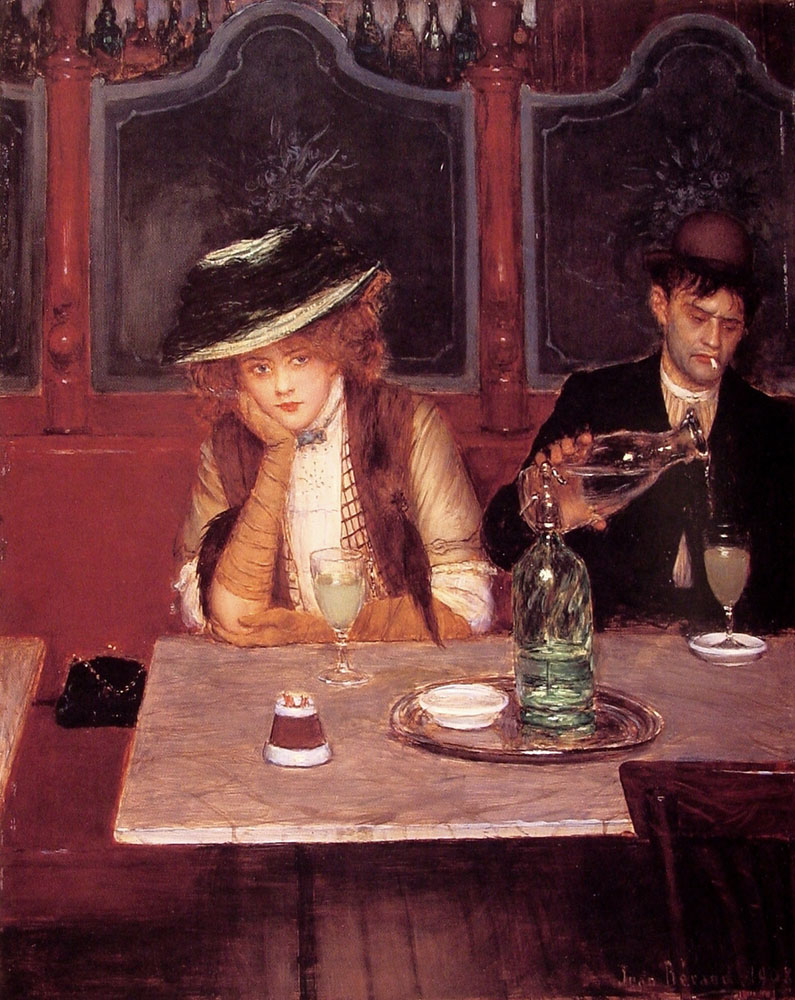
Le Cercle D'Ennui


Jean Béraud : The Drinkers, 1908 - Oil on panel